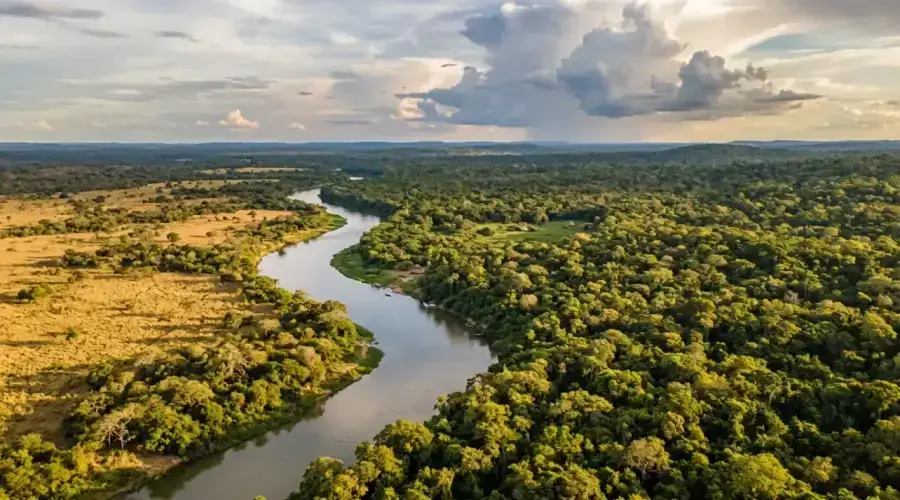
Paraguay is a country best understood by its contrasts. On one side, a fertile, humid, populated and agricultural East. On the other, a vast, dry, nearly empty and wild West. Between them, the Paraguay River traces a line of force that separates two geographies and draws two ways of inhabiting the territory. With its 6.1 million inhabitants, its Spanish-Guaraní bilingualism, its ever-living indigenous heritage and its central place in the Southern Cone, Paraguay stands apart on the continent. Discreet by the scale of the great South American narratives, but of a rare coherence when looked at closely.
Languages and linguistic identity
Since 1992, Spanish and Guaraní have been official languages (art. 140 of the Constitution). But in Paraguay, Guaraní is not a museum language or a simple identity symbol: it is spoken by an immense majority of the population, across all social classes, and remains a language of daily life, of intimacy and of humor. It is one of the few countries in the world where an indigenous language is majority without social exception.
On the street, conversations naturally slip into Jopará, that mix of Guaraní and Spanish that gives the country its own musicality: the same dialogue can start in Spanish, end in Guaraní and slip in a Brazilian slang word in the middle. Paraguayan Spanish also has its distinctive features: voseo is widespread and numerous words are taken from Guaraní.
No other Latin American country has given an indigenous language such a real status. Guaraní is taught in schools, heard in ministries and written in the press. Its survival is due to its use as a language of intimacy, even in the wealthiest neighborhoods of Asunción.
This linguistic uniqueness has a history. Unlike other colonial empires, the Jesuits did not impose Spanish in their reductions: they learned Guaraní, standardized it, made it a language of evangelization and administration. When the Jesuits were expelled in 1767, Guaraní was already a written, taught and standardized language, a case without parallel in the colonial history of the Americas. After independence (1811), dictator Francia prohibited mixed marriages between Europeans and criollos, reinforcing the use of Guaraní as a language of the private sphere and of resistance to the Hispanic model. In the 20th century, the Chaco War (1932-1935) consolidated Guaraní as a language of national cohesion: soldiers spoke Guaraní in the trenches, and military communications used that language which the Bolivian enemy did not understand. The official language status obtained in 1992 is therefore the result of a four-century process.
Physical geography
Paraguay is structured by a very marked geographic divide. In the east, the Paraneña region concentrates most of the population, agricultural lands, gentle hills and abundant rainfall (1,200 to 1,800 mm/year). Its red soils, of basaltic origin, sustain most of the national agriculture, while the relief culminates at Cerro Peró (842 m), the highest point in the country.
In the west, the Chaco occupies 60% of the territory for barely 2% of the population. An almost perfectly flat sedimentary plain covering 246,000 km², it gives the country an impression of nearly infinite space. The Paraguay River (2,695 km) acts as a structuring axis, while the Paraná sustains the Itaipú dam (14 GW), the second largest hydroelectric dam in the world by annual production, built binationally with Brazil. Downstream, Yacyretá (3.1 GW), co-managed with Argentina, completes the setup.
Water shapes Paraguay more than any mountain or sea. The dams are not a technological parenthesis: they became the second pillar of the national economy. The country sells its electricity to its neighbors at preferential rates, turning its rivers into a strategic income.
The Paraná River (4,880 km), the second longest in South America after the Amazon, forms the eastern and southern border of the country for nearly 700 km. It sustains the two largest dams in Paraguay: Itaipú (14 GW, inaugurated in 1984, binational with Brazil) and Yacyretá (3.1 GW, commissioned between 1994 and 1998, binational with Argentina). The Paraná has an average flow of 17,290 m³/s at its confluence with the Paraguay. The Paraguay River (2,695 km), for its part, is slower (a drop of 127 m over 2,300 km in Paraguayan territory), navigable along almost its entire Paraguayan course and sets the rhythm of the humid Chaco. These two waterways define the borders and the economy of the country more decisively than any mountain range.
The Chaco deserves a more precise description. It covers 246,000 km², 60% of the national territory, but is home to less than 200,000 inhabitants. It is a quaternary sedimentary plain, shaped by the fluvial erosion of the Pilcomayo and Bermejo rivers. The eastern half of the Chaco (humid Chaco) receives between 800 and 1,200 mm of rain per year and supports a dense forest of red quebracho, palo santo and labón. The western half (dry Chaco) receives less than 500 mm/year: wooded savanna, cacti, saline soils. The most emblematic species is the quebracho, a tree with wood so hard it "breaks the axe" (quiebra-hacha), exploited for its tannin since the 19th century. The Chaco is also the habitat of the jaguar, the puma, the giant armadillo and the rhea. The Transchaco (route 9), 830 km from Asunción to the Bolivian border, is the only paved axis crossing this space.
Climate and seasons
The Paraguayan climate is subtropical, but varies strongly between East and West. Summer (December-February) exceeds 38 °C with relative humidity of 70 to 80% in the Paraneña, a heavy heat that slows everything down and imposes the rhythm of tereré. In the Chaco, the thermometer can reach 45 °C in the shade in January, with nights still above 25 °C.
Austral autumn (March-May) and spring (September-November) offer the most pleasant temperatures, around 25 °C during the day, 15 °C at night. This is the best window for tourism. Winter (June-August) remains mild: 17 °C average in Asunción, with cool nights (5-10 °C) and sometimes morning fog. The surazos (cold waves from the south) can bring the thermometer down to 2 °C in July, but that never lasts more than 2-3 days.
| When to go based on your trip | |
|---|---|
| General tourism | March-May or September-November (25 °C, little rain) |
| National parks, Chaco | May-September (dry season, passable tracks) |
| Encarnación Carnival | January-February (hot, very busy) |
| Jesuit missions | Avoid December-January (extreme heat) |
| Independence Day | May 14-15 (parades, national atmosphere) |
| Caacupé Pilgrimage | December 8 (1.5 M faithful) |
Population and demographics
The latest census (INE, 2022) gives 6,109,903 inhabitants. Annual growth is 1.2%, slowing compared to previous decades. Asunción and its metropolitan area (Greater Asunción) concentrate nearly 2.2 million inhabitants, or 36% of the national population. Other major cities include Ciudad del Este (about 300,000 inhabitants), Encarnación (130,000 inhabitants) and Luque (120,000 inhabitants).
Paraguay has one of the youngest populations in Latin America with a median age of 27, a considerable demographic advantage in a rapidly aging region. But this youth faces selective emigration toward Spain, the United States and Argentina, partly offset by arrivals: the brasiguayos (Brazilians settled in the East) and Mennonite communities from Europe.
Economy
The Paraguayan economy rests on three pillars: agribusiness, hydroelectricity and border trade. Soybeans are the top export product (about 10 billion dollars per year), followed by beef, corn and rice. Paraguay is the 4th largest soybean exporter and the 6th largest beef exporter in the world. Surprising figures for a country of 6 million inhabitants.
- 1Agribusiness: soybeans, beef, corn, rice. 20% of GDP, driver of rural employment
- 2Hydroelectricity: Itaipú (14 GW) + Yacyretá (3.1 GW). Strategic income, 1st world exporter of electricity per capita
- 3Border trade: Ciudad del Este, thousands of sacoleiros cross the Friendship Bridge every day
Nominal GDP reached 44.2 billion dollars in 2023 (IMF), with a GDP per capita of 7,200 USD (PPP). Inflation is historically moderate for the region (around 4-6%). The main trading partners are Brazil, Argentina and China. Ciudad del Este embodies the second face of the country: that of resale trade, purchasing flows and the circulation economy. The result is more complex than it seems, with strong inequalities between the Paraneña and the Chaco.
Two aspects of the Paraguayan economy deserve special mention. The first is the informal economy. According to the International Labour Organization (ILO), informal employment represents about 65% of non-agricultural employment in Paraguay. Street markets, street vendors, cross-border resale, small family workshops: all of this constitutes a considerable part of daily economic life. For the traveler, this means that much of what you buy (handicrafts, food, local transport) goes through undeclared circuits. The second is Law 60/90, known as the maquila law: a very favorable tax regime that allows foreign companies (especially Brazilian and Asian) to produce in Paraguay for re-export, benefiting from almost total tax exemption. Maquilas employ about 30,000 people, mainly in textiles, automotive assembly and electronic parts. Ciudad del Este and Hernandarias concentrate the majority.
In Greater Asunción, an entrepreneurial scene has emerged since the 2010s: tech startups (fintech, agritech), incubators such as the Universidad Nacional Business Incubator, and a connected urban middle class. Paraguay also attracts Chinese investors, especially in infrastructure (the bioceanic corridor project connecting the Chilean port of Antofagasta with the Brazilian port of Santos through the Paraguayan Chaco). This contrast between high-tech export agriculture of soybeans, low-cost maquilas, massive informality and the emergence of a modest tech scene gives the Paraguayan economy a very composite picture.
Politics and institutions
Paraguay is a presidential republic. The 1992 Constitution, adopted after the fall of Alfredo Stroessner (35-year dictatorship), establishes the separation of powers. The president is elected for 5 years, without re-election. The single term was introduced by an amendment in 2022. Parliament is bicameral: Senate (45 members) and Chamber of Deputies (80 members).
The two major parties are the Colorado Party (conservative, in power for most of recent history) and the Authentic Radical Liberal Party (center-right). The current president is Santiago Peña (elected in 2023, Colorado). The country is a founding member of Mercosur (1991) and is part of the UN, the OAS and UNESCO.
When to come?
The best time to visit Paraguay remains the austral autumn (March-May) and spring (September-November), when temperatures are mild and travel is comfortable. But the right time depends on what you are looking for: festivals, parks, the river or the Chaco do not respond to the same seasons.
- 1Autumn (March-May): ideal for everything. Pleasant temperatures, moderate crowds.
- 2Spring (Sept-Nov): comparable, with more heavy storms in November.
- 3Summer (Dec-Feb): Encarnación Carnival, but heavy heat (38-45 °C).
- 4Winter (June-Aug): dry, pleasant for the Chaco, cool nights.
For national parks and Chaco tracks, prioritize the dry season (May-September). For the Encarnación Carnival, aim for January-February, but expect heat and crowds. The independence celebrations (May 14-15) and the Caacupé pilgrimage (December 8) are strong cultural moments where attendance is very high.
Transport and access
Paraguay is mainly reached by plane through Silvio Pettirossi International Airport in Asunción (ASU, 16 km from the center) and Guaraní International Airport in Ciudad del Este (AGT). Direct flights from Europe are limited: Air Europa connects Asunción from Madrid (3 flights per week). Regional airlines (LATAM, Paranair, JetSmart, Azul) connect Asunción with Buenos Aires, São Paulo, Santiago and Lima.
| How to get there and get around | |
|---|---|
| Plane | ASU (Asunción) or AGT (Ciudad del Este). Flights from Madrid, Buenos Aires, São Paulo |
| International bus | Buenos Aires (18h), Foz do Iguaçu (1h), Santa Cruz (20h) |
| Long-distance bus | 30,000-100,000 Gs (4-14 €). Companies: Godoy, NSA |
| Uber / Bolt | Available in Asunción. Very low prices |
| Car rental | From 200,000 Gs/day (27 €). Localiza, Hertz |
The country maintains a fairly simple access logic for the independent traveler, though less "ultra-connected" than some more touristic neighbors. That is part of its charm: you still travel with some method and anticipation. Long-distance buses connect all cities at ridiculously low prices, a bargain for tight budgets.
Currency and travel budget
The guaraní (PYG) is the national currency. In August 2026, 1 € exchanges for about 6,880 PYG on the interbank market (Xe.com, August 2026), with a stable level over the last 90 days. To simplify calculations on the ground, the rounding 1 € ≈ 6,900 Gs is commonly used. Paraguay is one of the most affordable countries in South America, making it an ideal destination for long stays or exploratory trips: here, a good meal does not exceed a few euros.
Average price references (August 2026)
| Average price references (August 2026) | |
|---|---|
| Street food (empanada, chipa, cocido) | 20,000-40,000 Gs (3-6 €) |
| Lunch at restaurant (menu of the day) | 55,000-110,000 Gs (8-16 €) |
| Dinner with drink | 80,000-150,000 Gs (12-22 €) |
| Budget hotel / hostel night | 140,000-280,000 Gs (20-40 €) |
| Mid-range hotel night | 320,000-550,000 Gs (45-80 €) |
| Liter of gasoline | 11,500 Gs (1.65 €) |
| Interurban bus (≈ 200 km) | 65,000-80,000 Gs (9-12 €) |
| Chopp (1 glass 500 ml) | 15,000-25,000 Gs (2-3.50 €) |
| Coffee at the counter | 10,000-15,000 Gs (1.50-2.20 €) |
| Car rental (per day) | 350,000-500,000 Gs (50-70 €) |
Payment and exchange
| Payment and exchange | |
|---|---|
| Bank cards | Accepted in 70-80% of urban commerce in Asunción, 50% in Ciudad del Este and Encarnación. Almost systematically rejected in rural markets and with artisans. |
| ATMs | Available in Asunción and departmental capitals (Banco Itaú, BCP, BBVA, Continental). Maximum withdrawal ~ 2,000,000 Gs (~290 €) per transaction. |
| Currency exchange | US dollars and euros are exchanged everywhere. Rate often better in the city than at the airport (2-3% difference). Avoid exchange houses at the Triple Frontier in Ciudad del Este. |
| Prepaid card (Wise, Revolut) | Rate generally better than local banks. To prioritize for a travel bank card. |
A tip: exchange upon arrival in the city (Asunción microcenter) rather than at the airport. ATMs in Asunción usually give a better rate than manual exchange. For informal transactions (artisans, markets), have small bills of 10,000 and 50,000 Gs ready: vendors do not always have change for 100,000 Gs.
Language and communication
Spanish and Guaraní are everywhere, but communication remains easy for a Spanish-speaking traveler. In tourist areas, some English is found in high-end hotels and restaurants, but signs and menus are almost exclusively in Spanish. A basic level of Spanish is enough to get by.
- 1Maitei: hello
- 2Aguyje: thank you
- 3Vy'apave: welcome
- 4Jahata: see you later
- 5Iporã: nice / good
What matters here is not linguistic performance, but goodwill. Paraguayans react very positively to effort, even if imperfect. Greeting in Guaraní, thanking, showing interest: these small gestures open many doors. Guaraní has only 12 consonants and 6 vowels, with stress on the last syllable: a surprisingly accessible language.
Safety and health
Paraguay is generally a safe country for travelers, with a lower rate of violent crime than its Brazilian and Argentine neighbors. Basic precautions are enough: avoid displaying valuables on public transport, do not walk alone at night in remote neighborhoods, lock doors at traffic lights. Pickpockets are active in markets (Mercado 4) and bus terminals.
- 1Do: travel insurance with repatriation, mosquito repellent, hepatitis A and typhoid fever vaccines recommended
- 2Avoid: displaying valuables on transport, walking alone at night in isolated neighborhoods
- 3Malaria: Paraguay was certified malaria-free by WHO (2018). No cases in the country.
- 4Dengue: endemic, especially in summer. Use repellent
Healthcare quality varies: private hospitals in Asunción (Hospital Sirio-Libanés, Hospital San Roque) are of good standard, but public hospitals are poorly equipped outside major cities. There are no mandatory vaccines, but hepatitis A, typhoid fever and tetanus are recommended. Travel insurance with repatriation is essential.
What defines the country's identity
Paraguay is hard to sum up in a single word, but three ideas come up repeatedly: real bilingualism, territorial contrast and the ability to make different worlds coexist. It is both rural and urban, river and plain, traditional and strategic, discreet and very coherent.
It is a country best described by observing its balances rather than listing its features. Its identity lies in a diagonal: from the arid Chaco to the Atlantic forest, from patriotic commemorations to shared tereré, from the red earth to the giant dams. It is not understood at a glance. It is understood in layers.
- 1For living culture: a country where Guaraní is spoken in ministries
- 2For wide open spaces: the Chaco, one of the last truly inhabited deserts of the Americas
- 3For language: bilingualism found nowhere else on the continent
- 4For a direct relationship with the territory: you still travel with method and anticipation
- 5For a less expected South America: far from the beaten paths of mass tourism
National symbols
Paraguay has several distinctive national symbols. Its flag, adopted in 1842, is the only one in the world with two different faces: the obverse shows the three stripes red, white and blue with the national emblem in the center (the May star surrounded by a wreath), while the reverse shows the lion of the Republic with the Phrygian cap, guarding the motto "Peace and Justice". The colors evoke a triple heritage: red for courage, white for peace and blue for freedom.
The national anthem, composed by Uruguayan Francisco Acuña de Figueroa to music by Uruguayan Francisco José Debali, was first performed in 1846. The national coat of arms features the May star on a circular background surrounded by a palm branch and an olive branch, tied by a ribbon in the colors of the flag.
The national flower is the mburucuyá (blue passionflower, Passiflora caerulea), a climbing plant whose shape evokes for some the crown of thorns and for others a subtropical forest flower. The national tree is the lapacho (Handroanthus impetiginosus), which blooms in intense pink before the leaves appear in July-August. The National Pantheon of Heroes in Asunción, a replica of the Parisian Invalides, houses the remains of Francisco Solano López, Carlos Antonio López, heroes of the Chaco War and the Unknown Soldier. The changing of the guard is daily.
Territorial organization
Paraguay is divided into 17 departments plus the capital Asunción, which forms an autonomous district. The division dates from 1992 (Constitution, art. 156-160) but was stabilized by law 351 of 1993. East of the Paraguay River, 14 departments concentrate almost all the population and economic activity, from Concepción in the north to Itapúa and Misiones in the south. To the west, 3 departments occupy the vastness of the Chaco: Presidente Hayes, Boquerón and Alto Paraguay.
| The 17 departments of Paraguay | ||
|---|---|---|
| Concepción | Concepción | North, Paraguay River |
| San Pedro | San Pedro de Ycuamandiyú | Central-east, agriculture |
| Cordillera | Caacupé | Center, pilgrimage |
| Guairá | Villarrica | Central-south, universities |
| Caaguazú | Coronel Oviedo | East, agribusiness |
| Caazapá | Caazapá | Southeast, Franciscan missions |
| Itapúa | Encarnación | South, carnival + Jesuits |
| Misiones | San Juan Bautista | South, Jesuit missions |
| Paraguarí | Paraguarí | Center, colonial history |
| Alto Paraná | Ciudad del Este | East, trade + Itaipú |
| Central | Areguá | Greater Asunción area |
| Ñeembucú | Pilar | Southwest, wetlands |
| Amambay | Pedro Juan Caballero | Northeast, Brazilian border |
| Canindeyú | Salto del Guairá | Northeast, soybeans |
| Presidente Hayes | Villa Hayes | Central Chaco |
| Boquerón | Filadelfia | Western Chaco, Mennonites |
| Alto Paraguay | Fuerte Olimpo | Northern Chaco, Pantanal |
Each department has a governor elected for 5 years and a departmental board (equivalent to a general council). The budget and competencies are limited: departments mainly manage secondary roads, schools and rural health centers. Power remains highly concentrated at the national level. The departmental map has changed little since the 1990s, but the demographic weight of Greater Asunción (Central + capital) keeps increasing: 36% of the population on less than 1% of the territory.
Main cities
The Paraguayan urban network is very unbalanced. One overgrown capital, two dynamic secondary poles, some medium-sized cities with regional function and a largely underserved rural interior. Here are the 8 cities that structure the territory.
- 1Asunción (521,000 inhabitants, Greater Asunción ~2.2 M). Capital since 1537, political, cultural and economic center. The city preserved a readable colonial center with the metropolitan cathedral, the Cabildo and the López Palace. Neighborhoods to explore: Villa Morra (shopping, dining), Loma San Jerónimo (colorful hillside neighborhood), the Costanera (recent riverside promenade).
- 2Ciudad del Este (300,000 inhabitants). Second city of the country, founded in 1957. The city of border trade: the Friendship Bridge connects it to Foz do Iguaçu (Brazil). Thousands of sacoleiros cross every day. Ciudad del Este is also the gateway to Itaipú, the Iguazú Falls on the Brazilian side and Shopping China, a temple of imported electronics. Chaotic, noisy, with a very particular energy.
- 3Encarnación (130,000 inhabitants). Capital of Itapúa, the "Pearl of the South". Facing Posadas (Argentina), connected by the San Roque González bridge. River beaches, national carnival, Jesuit missions of Trinidad and Jesús 30 km away. A regional center that underwent a major urban transformation around its waterfront.
- 4Luque (120,000 inhabitants). Suburb of Asunción but autonomous city, home of Silvio Pettirossi international airport. Known for its silver craftsmanship (filigree), its silversmiths and the Silver Museum. One of the oldest cities in the country, founded in 1635.
- 5Filadelfia (18,000 inhabitants). Center of Mennonite colonization in the central Chaco, founded in 1930. Museum of the Mennonite colonies, model agricultural cooperative, gateway to the dry Chaco. Far from everything (450 km from Asunción), but essential for anyone wanting to understand Paraguay today.
- 6Villarrica (70,000 inhabitants). Capital of Guairá, university and cultural center of the central-south. Founded in 1570, moved 7 times before settling in 1682. Known for its local carnival, leather craftsmanship and nearby Ybytyruzú hill. A nice provincial town with a strong identity.
- 7Concepción (50,000 inhabitants). River port on the Paraguay River, in the north. Founded in 1787, it experienced economic boom in the 19th century with quebracho, timber and leather. Today, Concepción is a city of character, with low colonial houses, a still-active port and a direct relationship with the river. A logical stop on the Pantanal route.
- 8Pedro Juan Caballero (120,000 inhabitants). Capital of Amambay, bordering Ponta Porã (Brazil). The two cities touch: a single street separates the two countries. Intense trade, smuggling, sometimes elevated insecurity. Paradoxically, Cerro Corá, where Solano López died in 1870, is 40 km away: a place of national memory in a city of wild globalization.
These eight cities map out contemporary Paraguay. You will necessarily pass through them if you travel for more than a few days. Each has its character, its function and its place in the national puzzle.
A first trip to Paraguay: 10-day itinerary
Here is a concrete itinerary for a visitor discovering the country, without their own vehicle. It combines the capital, the Jesuit missions, the carnival (or beaches depending on the season) and an incursion into Paraguayan nature. Distances are calculated in hours by bus.
| Typical itinerary, 10 days | ||
|---|---|---|
| D1-2 | Asunción | Arrival ASU. Historic center (Cathedral, Cabildo, López Palace, National Pantheon). Mercado 4 for breakfast (empanada + cocido). Evening on the Costanera. Budget per night: 150,000-300,000 Gs (20-40 €) |
| D3 | Areguá (day trip) | 28 km from Asunción, bus 7,000 Gs. Lake Ypacaraí, black pottery, strawberry fields. A Sunday if possible: local atmosphere, artists. Return in the evening. |
| D4-5 | Encarnación (bus 6h) | Morning departure from Asunción bus terminal. Arrival early afternoon. Waterfront, San José beach. D5: Jesuit missions (Trinidad + Jesús, 30 km by taxi or local bus). Night show in Trinidad if available. |
| D6 | Encarnación → Ciudad del Este (bus 4h) | Free morning in Encarnación. Bus to CDE. Arrival late afternoon. Shopping China if curious. Night in CDE: 150,000-250,000 Gs. |
| D7 | Itaipú + Iguazú Falls | Morning: visit to Itaipú dam (free, reservation recommended). Afternoon: crossing the Friendship Bridge to Foz do Iguaçu (Brazil, visa depending on nationality). Iguazú Falls on the Brazilian side (half day). Return to CDE in the evening. |
| D8 | CDE → Asunción (bus 7h or flight) | Bus or Paranair flight (45 min, ~80 €). Arrival in Asunción. Free evening: dinner in Villa Morra or Loma San Jerónimo. |
| D9 | Nature near Asunción | Option 1: Ybycuí National Park (2h by bus, waterfall, forest). Option 2: Itauguá (ñandutí, lace). Option 3: San Bernardino (lake, weekend atmosphere). Return to Asunción in the evening. |
| D10 | Departure | Last morning: tereré at Carlos Antonio López Park. Return flight. |
This itinerary can be adapted for all seasons. In summer (January-February), prioritize the carnival in Encarnación. In winter (June-August), replace Encarnación with an incursion into the Chaco (Filadelfia via Loma Plata, bus from Asunción, 7h). Paraguay lends itself well to improvised travel: buses leave when full, schedules are indicative, and hospitality more than makes up for any unforeseen events.
Last updated:
Sources
- National census 2022, INE Paraguay (2022)
- Constitution of Paraguay (1992), art. 140 (1992)
- IMF - Paraguay Economic Data 2023 (2023)
- World Bank - Paraguay Overview (2024)
- CIA World Factbook - Paraguay (2025)
- Central Bank of Paraguay - Economic Statistics
- SENATUR - Paraguay Tourism Portal
- Economist Intelligence Unit - Democracy Index 2024 (2024)
- Encyclopædia Britannica, Paraguay (2026)
- UNESCO - World Heritage Sites in Paraguay
My method
This page is written from France, sourced as carefully as possible, but I can be wrong or miss on-the-ground detail. A price that changed, outdated info, a photo to share? Every correction is credited if you want.
Report an error or send info →Share