Paraguay has a history of immemorial territory, of living Guarani heritage, of early mixing, of extraordinary political experiments and of a rare capacity to rebuild. Its identity is forged by language, land and sovereignty.
Before Europe: the Guarani substratum
Long before the arrival of Europeans, the region between the Paraguay and Parana rivers was occupied by Guarani populations, present since approximately 2000 to 1000 BCE. Their world was based on organized villages, cultivation of corn, manioc and sweet potato, hunting, fishing and mobility adapted to tropical environments. This period is Paraguay's first substratum: a cultural matrix whose imprint is still found in practices, imaginations and the central place of Guarani heritage.
Asuncion and the invention of mixing
The first Spanish settlers established around Asuncion found neither gold nor silver. So they settled differently, embedding themselves in a space already structured by the Guarani. Very early on, colonial Paraguay was founded on human bonds, land and the fusion of two cultural universes. Within a generation, the population had become mixed. In two generations, Guarani had displaced Spanish in homes.
The Jesuit missions: an unprecedented experiment
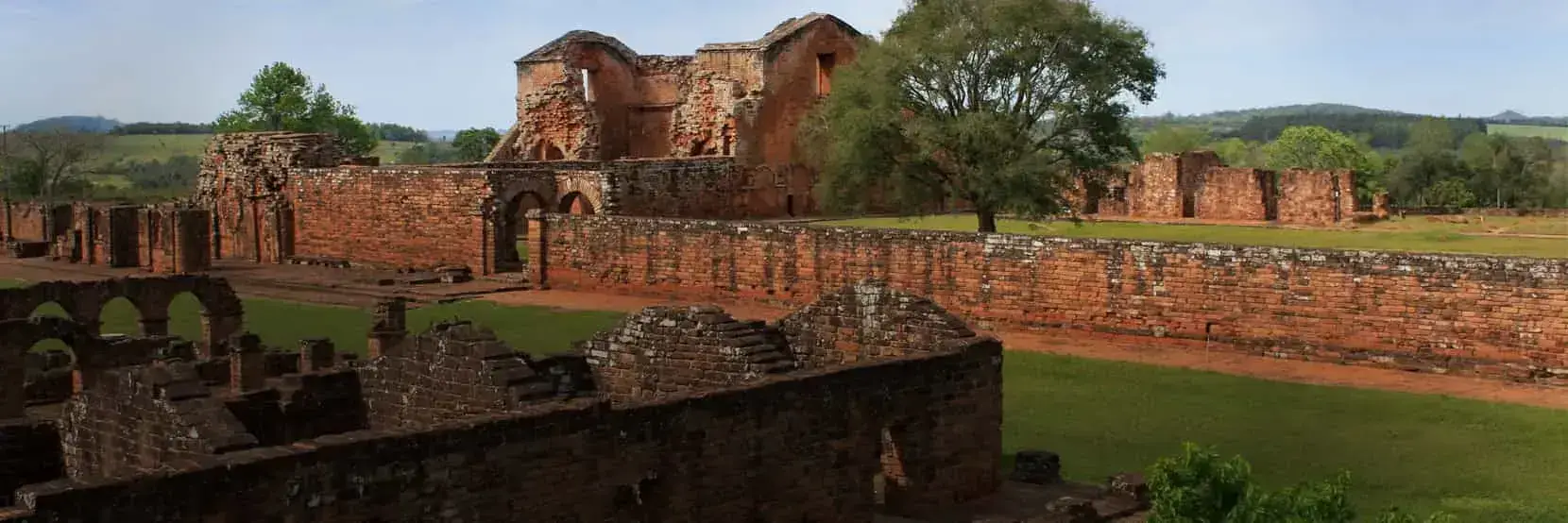
For more than 150 years, the Jesuit missions of the Rio de la Plata basin organized the lives of some 150,000 indigenous people in 30 reductions, 7 of which are in present-day Paraguay. These reductions were at once places of evangelization and centers of agricultural production, education, crafts, music, urban organization and protection against the encomienda system.
The sites of La Santisima Trinidad de Parana and Jesus de Tavarangue, declared UNESCO World Heritage, show a rare fusion between indigenous traditions, Christian symbolism and Baroque, Romanesque and Mudéjar influences. This past gives Paraguay an unusual cultural depth: here, religious history is also a history of urban planning, music, art and encounter between worlds.
1811: an early independence
After repelling the forces of Manuel Belgrano, Paraguayan patriots deposed the colonial governor and proclaimed independence on May 14, 1811. This break asserts a lasting trait of the country: the will to decide its own destiny alone.
Francia: sovereignty and self-sufficiency
Jose Gaspar Rodriguez de Francia became perpetual dictator in 1816. His power was authoritarian, distrustful, centralizing. He isolated Paraguay, limited external exchanges, weakened the elite, reduced the influence of the Church and brought lands into state ownership. His legacy is ambivalent. Francia also left a largely self-sufficient country, politically coherent and clinging to its sovereignty. Paraguayans call him El Supremo. Writer Augusto Roa Bastos would make him the hero of I, the Supreme.
Triple Alliance: the trial and the rebirth
Under Francisco Solano Lopez, Paraguay entered war against a united Brazil, Argentina and Uruguay. From 1864 to 1870, the War of the Triple Alliance devastated the country.
The figures are unbearable: 60% of the population disappeared. Political reconstruction was undertaken with the constitution of 1870. The country preserved its existence as a State despite a very unfavorable environment.
The Chaco: a foundational victory
The Chaco War against Bolivia broke out in 1932. Ceasefire in 1935, peace treaty in 1938: Paraguay obtained three-quarters of the Chaco. This victory, achieved at immense human cost, forged a story of courage, resistance and unity that still runs through collective memory. The abandoned forts can be visited today.
Stroessner and the democratic transition
The dictatorship of Alfredo Stroessner (1954-1989) imposed a long authoritarian system founded on repression and political closure, but also on profound transformations: the Itaipu dam, the largest in the world at the time, brought the country out of isolation and attracted massive investments. Since the fall of Stroessner and the Constitution of 1992, Paraguay has lived in a real but fragile democratic framework, marked by the weight of the Colorado Party and a persistent demand for justice and transparency.
- 135 years of dictatorship (1954-1989)
- 2Itaipu: the largest dam in the world at the time of its construction
- 31992: new democratic Constitution
- 4The Archives of Terror have been accessible since 2019
Paraguay today
Today's Paraguay carries a form of continuity: that of a country that has endured much but has preserved a clear identity. Guarani heritage, the memory of the missions, the importance of land, the centrality of sovereignty and the capacity for reconstruction give Paraguayan history a tone of its own in South America. Traveling through Paraguay means entering a history that is sometimes harsh, often surprising, but very human.
Why this history still matters
- 1Sovereignty: Paraguay always refused to let its neighbors or foreign powers dictate its course. From Francia to the Chaco War, this thread runs through the whole country.
- 2Mixing: long before it became a political topic, Guarani-Spanish mixing was an everyday reality. Paraguay is one of the few countries where the indigenous language still dominates.
- 3Resilience: Paraguay survived the most devastating war in Latin America, rebuilt itself and preserved its identity.
What to see on site
The ruins of the Jesuit missions of Trinidad and Jesus de Tavarangue, 30 km from Encarnacion, are the most impressive witnesses of the Jesuit experience. Declared by UNESCO, they embody a defining chapter of Paraguay's history. The Trinidad museum displays polychrome wood sculptures, Guarani little angels and period documents. On site, the silence is deafening. The wooden angels watch you from atop the red sandstone walls. Few travelers go there yet.
Last updated:
Sources
- Britannica - War of the Triple Alliance (2024)
- Dictatorship of Alfredo Stroessner (1954-1989) (2025)
- Constitution of Paraguay (1992) (1992)
- Britannica - History of Paraguay (2025)
- Museum of Independence - Casa de la Independencia
- National Archive of Asuncion
- Chaco War Museum
- History of Paraguay - Synthesis
- UNESCO - Jesuit Missions of La Santisima Trinidad and Jesus de Tavarangue (1993)
- UNESCO - Historical Archives of Paraguay
My method
This page is written from France, sourced as carefully as possible, but I can be wrong or miss on-the-ground detail. A price that changed, outdated info, a photo to share? Every correction is credited if you want.
Report an error or send info →Share