
Paraguay is the only country in the Americas where an indigenous language, Guaraní, is still spoken daily by the majority of the population, across all social classes, alongside the colonial Spanish language. This duality permeates everything: the economy, leisure, justice, sports, music and beliefs. It also explains why the country puzzles as much as it fascinates those who take the time to look beyond a simple tourist visit. This page explores the 7 dimensions that shape contemporary Paraguayan identity, each detailed on its own dedicated, sourced and dated page.
An identity forged by bilingualism
Since the 1992 Constitution, Spanish and Guaraní have been official languages on equal footing, but in practice Guaraní has always been the language of daily life, intimacy and humor, while Spanish remains associated with administration, school and formal media. This diglossia gives rise to jopará, a fluid mix of the two languages that is neither Guaraní nor Spanish but a third way, spoken without embarrassment on the street, on the radio and even in parliamentary debates.
This linguistic reality is not a folkloric relic: it shapes how Paraguayans joke, negotiate, pray and sing. Understanding this duality is arguably the most useful key to grasping the country beyond postcard clichés, whether it's following a market conversation, understanding a song on the radio, or picking up the nuances of a political rally.
Music, dance and popular arts
The Paraguayan harp, the country's signature instrument, accompanies the polca, a fast and festive dance, and the guarania, a melancholic genre invented by José Asunción Flores in the 1920s to express a nostalgia specific to Paraguay. The danza de la botella, where dancers balance bottles on their heads while spinning, remains the most reproduced image of Paraguayan folklore abroad, but it is only one facet of a living music scene that ranges from traditional folklore to a young urban scene (cumbia, Guaraní rap) largely ignored by conventional travel guides.
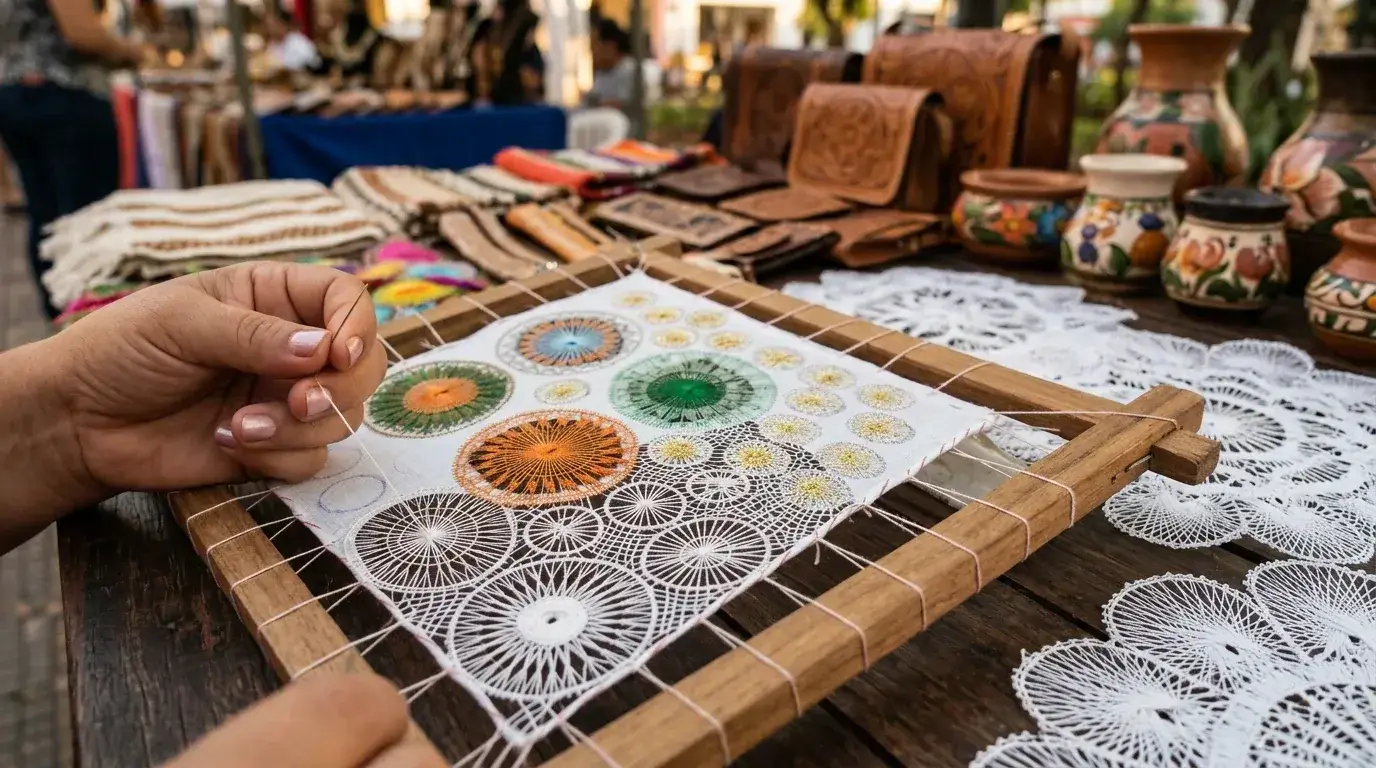
In crafts, ñandutí (spider-web lace) from Itauguá and ao po'i (finely embroidered lightweight cloth) rank among the finest textile skills on the continent, passed down almost exclusively from mother to daughter for generations. These crafts can be found in Asunción's markets and in specialized villages, where you can still watch the artisans at work rather than simply buying the finished product.
Religion, beliefs and the national sport
About 88% of the population identifies as Catholic, but actual practice often blends Catholic rites with older Guaraní beliefs, a syncretism especially visible every December 8th during the pilgrimage to Caacupé, one of the largest religious gatherings in South America. Rapid evangelical growth since the 1990s is gradually reshaping this religious landscape, particularly in urban areas and among working-class communities.
Football, for its part, functions as a genuine civil religion. The national team, nicknamed the Albirroja, put up a strong fight in the 2026 World Cup qualifiers, reviving a national enthusiasm that cuts across all social classes. Beyond football, the Transchaco Rally, an off-road race crossing the Chaco every year, and an active amateur practice of sport fishing and volleyball round out the country's sporting landscape.
Economy, games and the legal framework
The Paraguayan economy rests on three pillars rarely highlighted in travel guides: the soybean agribusiness, in which the country is one of the world's leading exporters, the hydroelectricity of Itaipú and Yacyretá, which make Paraguay a net exporter of clean energy, and the cross-border trade of Ciudad del Este, fueled by an attractive territorial tax regime that draws Brazilian and Argentine shoppers. This combination explains economic growth consistently above the regional average, contrasting with the country's low profile.
Paraguayan free time is organized around strong social rituals: sharing tereré (iced yerba mate, drunk in a circle through a shared metal straw, the bombilla) is an almost as important marker of belonging as language itself, and truco, a bluffing card game, fills family afternoons with codified gestural rules passed down orally. Institutionally, the 1992 Constitution sets up a presidential system with a theoretically independent judiciary, in a country divided into 17 departments, an organization worth understanding for anyone settling long-term or doing business locally.
Food and everyday lifestyle
Paraguayan cuisine, built on corn and cassava rather than wheat, tells the country's mixed-heritage story on its own. Chipa, a small cheese bread baked in a traditional wood-fired oven (the tatakua), is sold on every street corner and varies according to closely guarded family recipes. Sopa paraguaya, despite its name, is not a soup but a corn-and-cheese cake, born by accident according to legend when a presidential cook botched a porridge recipe. Vori vori, a chicken broth with corn dumplings, and mbeju, a cassava-starch flatbread, round out a culinary repertoire still largely unknown outside the country's borders.
Tereré structures social time far more than it quenches thirst: shared in a circle, with a common metal straw (the bombilla) planted in a single vessel (the guampa), it embodies an implicit hierarchy of who serves and who receives, and declining to take part can be read as a form of social withdrawal. The ritual changes shape in winter, giving way to hot mate, but the social logic stays the same: slow down, talk, share. It is arguably the best entry point for a curious visitor to understand Paraguayan culture from the inside rather than from a museum.
Why this section exists
Paraguayan culture cannot be reduced to a few tourist-brochure clichés. It is a living, everyday culture, passed on in the street through jopará, in craft markets, on football fields, and even in national legislation that has recognized Guaraní as an official language since 1992. Every page in this section is written with the same commitment as the rest of the guide: verified sources, visible update dates, and transparency about the nuances an outside perspective can miss. If you are Paraguayan and a page seems inaccurate to you, your correction via the Corrections page is welcome.
Last updated:
Sources
- Constitution of Paraguay (1992), art. 140 - official languages (1992)
- Secretaría Nacional de Cultura del Paraguay
- UNESCO, Tereré and Guaraní ancestral knowledge, intangible heritage (2020)
- Encyclopædia Britannica, Paraguay - Cultural life (2024)
- Wikipedia, Guaraní language
- Wikipedia, Jopará
- Banco Central del Paraguay - Economic statistics
- World Bank - Paraguay overview (2024)
- ABC Color, Paraguayan cultural news
- Wikipedia, Culture of Paraguay
My method
This page is written from France, sourced as carefully as possible, but I can be wrong or miss on-the-ground detail. A price that changed, outdated info, a photo to share? Every correction is credited if you want.
Report an error or send info →Share
Social codes worth knowing
What often surprises visitors
In professional settings, the personal relationship generally comes before the transaction: it's not unusual for a first meeting to end without any concrete decision, spent instead "getting to know each other." This approach can unsettle visitors from more direct cultures, but it reflects a notion of trust built over time rather than immediate efficiency. For expats and entrepreneurs settling long-term, absorbing these social codes considerably eases integration, often more than Spanish fluency alone.