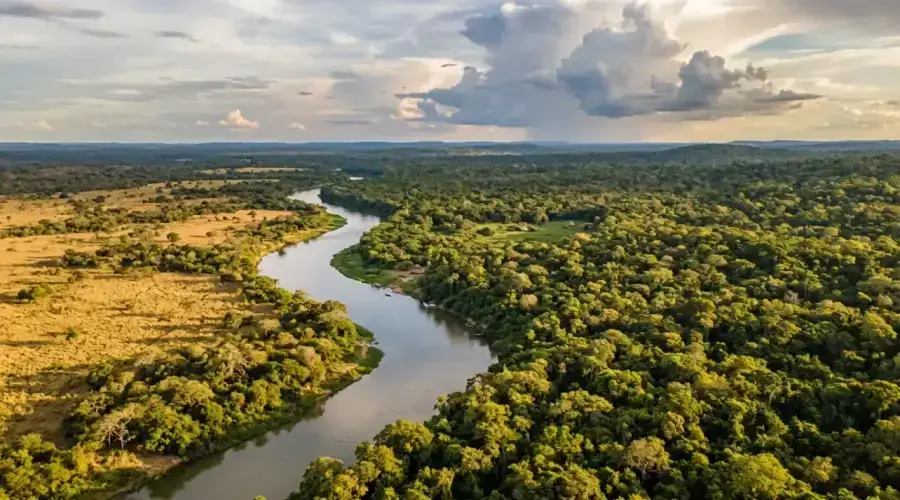
Paraguay protects a part of its territory in discreet, vast and often little-visited spaces. There you find immense dry Chaco parks, fragments of Atlantic forest, historic hills, Pantanal wetlands and private reserves active in conservation. These protected areas have nothing of the organized safari or the national park in the classic tourist sense. In Paraguay, protected nature remains sober, difficult to access, poorly equipped, sometimes austere.
Defensores del Chaco: solitude as landscape
Created on August 6, 1975, Defensores del Chaco National Park is Paraguay's largest protected area, covering some 720,724 hectares in the dry Chaco. It protects emblematic Gran Chaco fauna: jaguar, puma, anteater, tapir, giant armadillo, tagua. Xerophilous vegetation adapted to drought dominates, and Cerro Leon, a spectacular formation about 40 km in diameter peaking at 600 m, rises in the middle of the plain.
Defensores del Chaco is not an 'easy' park. Access is by land in a 4x4, entry is regulated by MADES, camping is allowed, and visiting means accepting a real degree of isolation. It is less a developed park than an experience of territorial grandeur. The biodiversity impresses, but the scale impresses even more. The silence, the horizontality and the feeling of being very far from everything give the park a rare, almost mental density.
- 1No mass tourism: a few visitors per month
- 2Little infrastructure: zero lodges, zero marked trails
- 3Immense distances: 8 park rangers for 720,000 hectares
- 4Sense of expedition: 4x4 mandatory, free camping
- 5Nature still sovereign: jaguar, puma, guanaco
Mbaracayu: the great forest memory of the East
In the east of the country, the great name in forest conservation is Mbaracayu. Two complementary realities must be distinguished: the Mbaracayu nature reserve (64,406 hectares), a forest core protected by the Moises Bertoni Foundation since 1991, and the Mbaracayu Forest Biosphere Reserve (553,569 hectares), recognized by UNESCO in 2000 in the upper Jejui basin.
The biosphere reserve is the first designated in Paraguay. It brings together semi-deciduous Atlantic forests, flooded forests, palm savannas, dry forests and agro-pastoral zones. The area hosts 89 mammal species, 19 of which are threatened (jaguar, puma, giant otter). More accessible than the Chaco (3h from Asuncion), it offers lodges, marked trails and guides. Entry: 50,000 Gs (7 EUR).
San Rafael (73,000 hectares, Atlantic forest) and Ypeti (5,000 ha, near Encarnacion) complete the network of eastern forest refuges. San Rafael offers one of the highest bird densities in the country (427 species). Ypeti is more accessible, with hikes, horseback rides and a comfortable lodge.
Cerro Cora, Pantanal and satellite reserves
Cerro Cora (5,538 ha) is a protected area apart, because it combines nature and national memory. It was there that Francisco Solano Lopez died on March 1, 1870, the episode marking the end of the War of the Triple Alliance. But reducing Cerro Cora to its historical importance would be a mistake. The park also offers a striking landscape experience, with its reliefs, its trails and its transitions between vegetation and territorial memory.
The Paraguayan Pantanal (50,000 km2, RAMSAR site since 2015) belongs to the largest wetland system in the world, shared with Brazil and Bolivia. Less known than the Brazilian portion, it is wilder, more silent and rarer. It is not a quick stopover destination: it is a territory of slow observation, where water decides everything. Maned wolf, marsh deer, yacare caiman, yellow anaconda and jabirus thrive there.
For travelers without full expedition logistics, Acahay Massif (700 m, 1h30 from Asuncion) is a granite inselberg accessible by regular car, popular among hikers. The Yacyreta reserve (2,500 ha), linked to the dam, offers easier observation of caimans, capybaras and water birds.
Where to go according to your profile
| Profile to Where to go | |
|---|---|
| Big nature, isolation | Defensores del Chaco: dry Chaco, expedition |
| Forest, biodiversity | Mbaracayu: Atlantic forest, UNESCO, 440 birds |
| History + nature | Cerro Cora: hike, memory, museum |
| Wetlands, birds | Paraguayan Pantanal: slow observation |
| Easy outing | Acahay Massif: hike, simple access |
| Easy observation | Yacyreta / Ypeti: caimans, birds, lodge |
The dry season (May-September) remains the best window for most of Paraguay's natural areas, especially in the Chaco, where tracks become impassable in the rainy season. For Defensores del Chaco, access is regulated by MADES park rangers. For Mbaracayu, logistics are simpler: marked trails, accommodation, guide. In all cases, plan for water, self-sufficiency and logistical margin. Local guides are often essential for understanding the terrain.
Threats, fragilities and reasons to go
Paraguay's protected areas are vast, but remain fragile. Pressure on the Atlantic forest (San Rafael lost 15% of its area between 2010 and 2020), ecological fragmentation, monitoring difficulties (8 rangers for Defensores) and the isolation of certain sites complicate large-scale conservation. Illegal deforestation and agricultural expansion are the most immediate threats.
That is why visiting here has almost political value: going to these parks, talking about them, documenting them and supporting local structures also contributes to their visibility. In a country where protected nature remains less covered by media than in its neighbors, the presence of attentive travelers can count.
Last updated:
Sources
- UNESCO MAB - Mbaracayu Forest (biosphere reserve) (2000)
- UNESCO - Medanos del Chaco tentative listing
- UNESCO - Defensores del Chaco tentative listing
- MADES - Defensores del Chaco Park
- MADES - National System of Protected Areas
- UNESCO - Defensores del Chaco National Park (tentative listing)
- Protected Planet - Pantanal Paraguay
- WWF Paraguay - Protected areas
- BirdLife - Paraguay IBA (Important Bird Areas)
- Moises Bertoni Foundation - Conservation areas
My method
This page is written from France, sourced as carefully as possible, but I can be wrong or miss on-the-ground detail. A price that changed, outdated info, a photo to share? Every correction is credited if you want.
Report an error or send info →Share