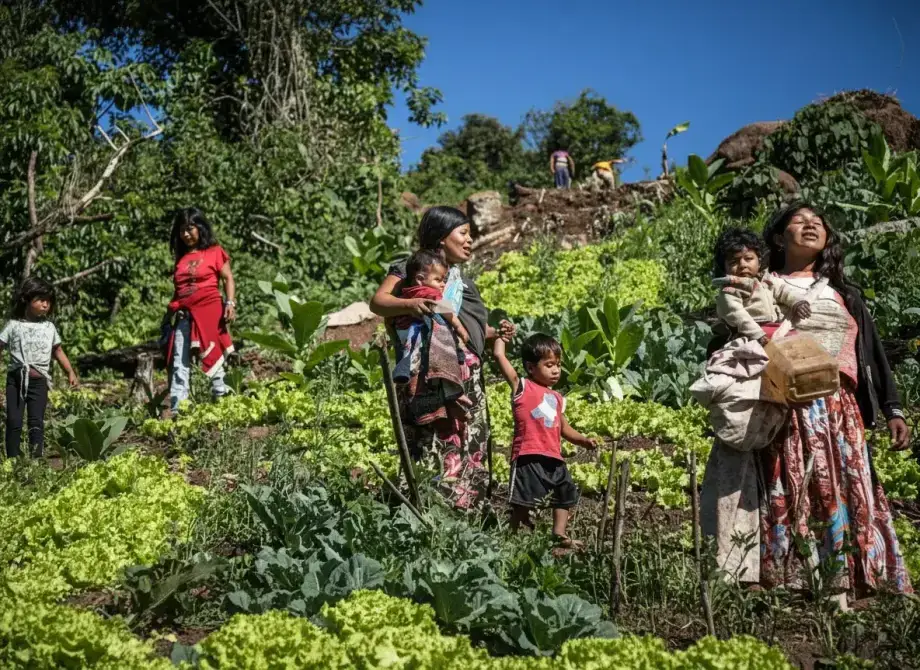
Paraguay is the only country in the Americas where an indigenous language is spoken by the majority of the population, including descendants of Europeans. According to the 2012 census, 77% of Paraguayans speak Guaraní, of which 8% are monolingual. Made official in 1992 alongside Spanish, this language endured colonization, dictatorship, and globalization without ever becoming a minority language : a phenomenon that linguists describe as exceptional on a continental scale.
A co-official language, a status won step by step
The essentials
- •Guaraní is the only majority indigenous language in the Americas: 77% of Paraguayans speak it, of which 8% are monolingual
- •Official language since 1992 alongside Spanish, it is spoken across all social classes, unlike anywhere else on the continent
- •Jopará is the Guaraní-Spanish mix used daily by around 90% of Asunción residents in informal exchanges
- •A few Guaraní words (mba'éichapa, aguyje) are highly appreciated by locals and make connecting easier
| Stages of Guaraní's legal status | |
|---|---|
| 1967 | Recognized as a «national language» by the Constitution, under the Stroessner dictatorship |
| 1992 | Elevated to official language, on equal footing with Spanish, by the new Constitution |
| 2010 | The Language Law affirms the effective equality of the two official languages and creates the Secretariat for Language Policy |
This belated official recognition contrasts with social reality: Guaraní never stopped being the language of the home, the market, and the countryside, even during the decades when only Spanish had legal status. It is a phenomenon that linguists describe as exceptional on a continental scale. Paraguay is the only country in the Americas where an indigenous language is spoken by the majority of the population, including descendants of Europeans who do not identify as indigenous.
The story of this survival is fascinating. Unlike other colonies where indigenous languages were systematically erased, the Jesuits chose to learn Guaraní in their reductions (17th-18th centuries), standardize it, and turn it into a written and printed language. When they were expelled in 1767, Guaraní was already a written and standardized language. After independence in 1811, dictator Francia reinforced its use by prohibiting mixed marriages between Europeans and creoles, which paradoxically protected the language in the private sphere.
Who speaks Guaraní, and where
Usage varies strongly by environment and region. Guaraní dominates in rural areas and the countryside, where it is the main language of daily life. In cities, especially Asunción, Spanish prevails in administration, business, and higher education. But even in the capital, Guaraní remains omnipresent in informal conversations, markets, public transport, and homes.
A striking peculiarity of Paraguay is that Guaraní is not associated with any particular social class. It is heard in ministries as well as in the most modest settlements. A banker may switch from Guaraní to Spanish depending on their interlocutor, without it seeming unusual. No other indigenous language of the Americas is spoken across all social classes this way.
Jopará, the Guaraní actually spoken daily
Jopará (meaning «mixture» in Guaraní) is the form actually spoken on the street, both in Asunción and throughout the rest of the country. It is a Guaraní that is grammatically structured, but sprinkled with lexical borrowings from Spanish, and sometimes the reverse. It is not a «degraded» Guaraní in the eyes of linguists, but a fully legitimate variety, used by an estimated 90% of residents in the Asunción region for their informal exchanges.
In practice, jopará manifests in sentences where the grammatical structure is Guaraní (word order, verbal prefixes, suffixes) but where nouns, verbs, and adjectives are borrowed from Spanish. For example, a Paraguayan will say «Che preocupá» (I'm worried): «che» means «I» in Guaraní, «preocupá» comes from Spanish «preocupado». Academic Guaraní, taught in school and used in literature, coexists with this mixed form without replacing it, and most speakers naturally switch between the two depending on context.
Why this language survived where so many others disappeared
Guaraní owes its survival to an unusual combination of historical factors. The first is the role of the Jesuit Reductions in the 17th and 18th centuries: missionaries taught, wrote, and printed in Guaraní instead of imposing Spanish, creating an early written tradition without equivalent on the continent. The second is Paraguay's geographic and cultural isolation during the post-colonial period.
The War of the Triple Alliance (1864-1870) paradoxically reinforced the use of Guaraní. During this devastating conflict that cost the lives of much of Paraguay's male population, Guaraní served as a code language among soldiers that the Brazilian, Argentine, and Uruguayan enemies did not understand. After the war, the language became a marker of national identity and resistance. In the 20th century, the Chaco War (1932-1935) consolidated this role: military communications in Guaraní and trench brotherhood anchored the language in national consciousness.
The final factor is demographic: Paraguay experienced late and less massive urbanization than its neighbors. The countryside, where Guaraní remained the dominant language, continued to supply cities with native speakers, thus maintaining the language's vitality despite pressure from Spanish in institutions.
Some essential words and expressions
| Basic vocabulary for travelers | |
|---|---|
| Mba'éichapa | Hello, how are you? (universal greeting) |
| Aguyje / Aguyjevete | Thank you / Thank you very much |
| Iporã | Good, nice, pleasant (used daily) |
| Tereré | Iced mate, Paraguay's national drink |
| Che | I, my (possessive pronoun widely used, even in local Spanish) |
| Ñande | We (inclusive, «all of us together», important concept in Guaraní culture) |
| Vy'apavẽ | Happiness, deep joy (Guaraní philosophical concept) |
| Tekó porã | «The good life», central notion of Guaraní ethics |
| Pende | You (familiar or plural) |
| Mba'épa rejapo | What are you doing? (common informal greeting) |
I advise all travelers to learn at least «aguyje» (thank you) and «mba'éichapa» (hello) before arriving in Paraguay. The effect on interactions is immediate: Paraguayans are surprised and delighted that a foreigner makes the effort to pronounce a few words in Guaraní. A conversation may well start in Guaraní and continue in Spanish; no one expects a visitor to master the language.
Guaraní in school, media, and literature
- 1Mandatory bilingual education in elementary school since the educational reform of the 1990s, with programs in Guaraní and Spanish
- 2Radio and television programs in Guaraní, especially in rural areas where radio reception is the main access to information
- 3The Academy of the Guaraní Language (created by the Language Law of 2010) is responsible for standardizing spelling, vocabulary, and promoting the language
- 4A living Guaraní literature, driven by contemporary authors such as Susy Delgado, Miguelángel Meza, and Lino Trinidad Sanabria
- 5Guaraní Day (Arandu Ka'aty) is celebrated every year on August 22 to value the language among younger generations
- 6Guaraní words have entered everyday English: «jaguar», «tapir», «pineapple», «toucan» all come from Guaraní, testament to the language's influence far beyond Paraguay
Last updated:
Sources
- Instituto Nacional de Estadística (INE) - Paraguay (2025)
- Guaraní language - linguistic overview (2025)
- Languages of Paraguay (2025)
- Law N° 4251 «De Lenguas» (BACN, official text) (2010)
- Jopará (Guaraní-Spanish mix) (2025)
- Jesuit reductions - history of Guaraní writing (2025)
- Demographics of Paraguay (2025)
My method
This page is written from France, sourced as carefully as possible, but I can be wrong or miss on-the-ground detail. A price that changed, outdated info, a photo to share? Every correction is credited if you want.
Report an error or send info →Share