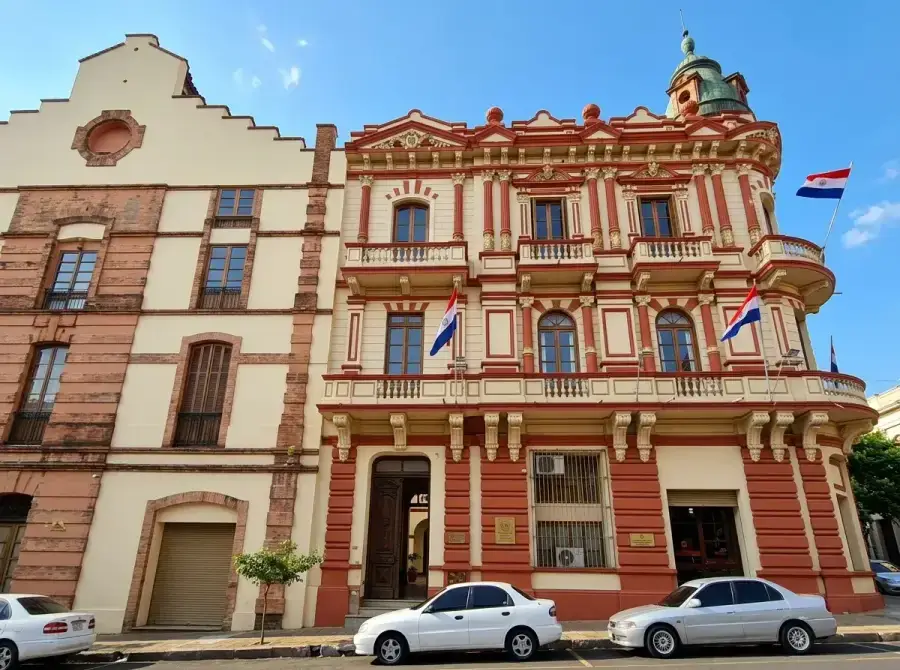

Asunción is the capital of Paraguay, and I often describe it as the most underrated city in South America. Founded on August 15, 1537 by the Spanish conquistador Juan de Salazar y Espinoza under the name Nuestra Señora Santa María de la Asunción, it is one of the oldest colonial cities on the continent, earning it the nickname "Mother of Cities": several expeditions that set out from here founded Buenos Aires, Santa Cruz de la Sierra, and Corrientes. With approximately 550,000 inhabitants in the city proper and nearly 2.2 million in the Greater Asunción metropolitan area, it concentrates a third of Paraguay's population. I have explored its neighborhoods, walked along its Costanera at sunset, and spent hours getting lost in its markets. What I found is a human-scale city, often overlooked by international travel circuits, but deserving a stop of at least two or three days. Unlike the frenetic metropolises of the region such as São Paulo or Buenos Aires, Asunción maintains a relaxed pace of life that you discover through walks and encounters, among colonial monuments and lively neighborhood life.
At a glance
Asunción at a glance
- •Capital since 1537, one of the oldest colonial cities in South America
- •Approximately 550,000 inhabitants in the city, 2.2 million in Greater Asunción
- •The Costanera, an 8 km riverside promenade along the Paraguay River
- •The National Pantheon, the López Palace, and the Cabildo: three key monuments
- •City of contrasts between colonial neighborhoods, business centers, and busy markets
- •Ideal starting point to explore the rest of the country
History and foundation
Asunción was founded on August 15, 1537, the day of the Assumption, by Juan de Salazar y Espinoza. The initial fort, built on the eastern bank of the Paraguay River, sought to protect the river route between present-day Argentina and Peru. Very soon, the city became the starting point for expeditions toward the Chaco, Brazil, and Bolivia. From 1537 to 1580, Asunción was the base from which Spanish colonists founded Buenos Aires (twice), Santa Cruz de la Sierra, and Corrientes. It is this expansion that earned it the nickname "Mother of Cities."
After Paraguay's independence in 1811, Asunción experienced accelerated growth under the regime of Carlos Antonio López (1844-1862), who commissioned the construction of the López Palace, the Cabildo, and the first railway line in South America, inaugurated in 1861. The War of the Triple Alliance (1864-1870) devastated the city: occupied by Brazilian troops from 1869 to 1876, Asunción lost much of its archives and heritage. It took half a century for the capital to recover. Today, the traces of this history are visible in the historic center, where 19th-century palaces coexist with contemporary buildings.
The historic center
The historic center of Asunción is compact and easily explored on foot. I recommend starting at the Plaza de los Héroes, around which the main monuments are concentrated. The National Pantheon of Heroes, built between 1864 and 1936, houses the remains of Marshals Carlos Antonio López and Francisco Solano López, as well as those of Marshal José Félix Estigarribia, hero of the Chaco War. A few steps away, the López Palace, seat of the government, overlooks the Paraguay River with its white and pink silhouette. Further south, the Cabildo, former seat of Parliament, now houses a cultural center with temporary exhibitions.
- 1López Palace: seat of the presidency, built between 1857 and 1867
- 2National Pantheon of Heroes: 32 m nave, mosaics, and stained glass
- 3House of Independence: colonial house where independence was prepared in 1811
- 4Metropolitan Cathedral: neoclassical cathedral, built between 1845 and 1849
- 5Cabildo: former Congress, now a cultural center
- 6Central Railway Station: historic station from 1861
The Costanera and the Paraguay River
The Costanera is the promenade that borders the Paraguay River for approximately 8 kilometers, between the city center and the Sajonia neighborhood. Developed from 2012 on former port lands, it has become Asunción's green lung and the favorite spot of Asunceños for sports, picnics, and watching the sunset. On weekends, hundreds of families settle in, chipa and tereré vendors circulate among the groups, and the atmosphere is deeply popular and relaxed. At the end of the Costanera, the Sajonia neighborhood houses the Botanical Garden and Zoo, as well as the Natural History Museum.
From the Costanera, you can see the twin city of San Antonio on the opposite bank. The Paraguay River, about 500 meters wide at this point, is navigated by transport barges and some pleasure boats. Boat excursions are organized from the port, offering a different perspective of the city's skyline. I recommend going in the late afternoon for sunset, when the López Palace takes on ochre tones under the oblique light.
Markets and local life
Mercado 4 (Market 4) is the epicenter of Asunción's popular commerce. Located between Dr. Francia and Montevideo streets, this giant market covers several blocks and concentrates hundreds of stalls: fruits and vegetables, meat, fish, handicrafts, clothing, electronics, medicinal herbs. It is a place of organized chaos where all social classes of Paraguay converge. There I tried chipa fresh from the oven, bought artisan yerba mate, and observed the daily life of the capital.
For a more touristy but equally authentic experience, the Mercado de la Recova, located under the arches near the port, offers Guaraní handicrafts, silver jewelry, ñandutí (traditional lace), hammocks, and musical instruments. Prices are higher than at Mercado 4 but the quality is usually better. The Loma San Jerónimo neighborhood, on the hills overlooking the Costanera, is also worth a visit for its colorful houses and village atmosphere in the middle of the city.
Upscale neighborhoods and nightlife
The Villa Morra and Carmelitas neighborhoods are the modern and affluent side of Asunción. There you will find shopping centers like Shopping del Sol and Paseo La Galería, gourmet restaurants, specialty coffee shops, and concept stores. This is where the most exclusive nightlife is concentrated, with cocktail bars, lounges, and nightclubs that stay open until dawn, especially on weekends. The Manduvirá neighborhood, more central, offers an alternative scene: tereré bars, rock and reggaeton concert venues, neighborhood restaurants.
| Asunción neighborhoods by interest | |
|---|---|
| Historic center | Monuments, museums, colonial and republican architecture |
| Villa Morra-Carmelitas | Shopping, restaurants, exclusive nightlife |
| Manduvirá | Alternative scene, concerts, local bars |
| Loma San Jerónimo | Panoramic view, colorful houses, handicrafts |
| Sajonia | Costanera, botanical garden, family outings |
| Mercado 4 | Popular commerce, street food, handicrafts |
Asunción cuisine
Asunción is the best place in Paraguay to discover the national cuisine in all its diversity. The restaurants in the center and residential neighborhoods offer all the classics: sopa paraguaya, chipa guasu, mbeju, vori vori, pira caldo. The markets like Mercado 4 are perfect for a quick and authentic lunch: you eat fried empanadas, chipa fresh from the oven, fresh cut fruits, and sugarcane juice pressed on the spot. The Villa Morra and Carmelitas neighborhoods concentrate the finest restaurants, with international cuisines (Japanese, Italian, Argentine, Peruvian) and Paraguayan chefs reinventing traditional dishes.
I especially recommend trying surubí a la paraguaya (river fish grilled with tomatoes and onions) and parrillada (assorted grilled meats), accompanied by a good Paraguayan wine or a traditional tereré. For lunch, many restaurants offer the menú ejecutivo, a daily fixed-price dish (approximately 25,000 to 40,000 Gs, about 3 to 5 €). Specialty coffee shops have emerged in recent years, especially in the Villa Morra neighborhood, offering quality Paraguayan coffee. Finally, do not leave Asunción without trying a coconut or guava ice cream from a street vendor, a true pleasure under the tropical heat.
- 1Surubí a la paraguaya: Paraguay River fish grilled, emblematic dish
- 2Parrillada: assorted meats, the Paraguayan equivalent of the Argentine asado
- 3Sopa paraguaya: the national dish, savory corn and cheese cake
- 4Chipa guasu: fresh corn and cheese cake, served as a side dish
- 5Vori vori: thick soup with corn flour dumplings and chicken
- 6Mbeju: cassava starch and cheese cake, crispy on the outside, soft on the inside
When to come and practical tips
| Useful information | |
|---|---|
| Best season | March-May and September-November (temperatures around 25-30 °C) |
| Avoid | December-February (high heat and humidity) and June-August (cool but pleasant) |
| Getting around | Center on foot, bus for outlying neighborhoods, taxis and Uber available |
| Accommodation | Villa Morra for comfort, center for heritage, Sajonia for tranquility |
| Recommended duration | 2-3 days for the essentials, 4-5 days to explore in depth |
Last updated:
Sources
My method
This page is written from France, sourced as carefully as possible, but I can be wrong or miss on-the-ground detail. A price that changed, outdated info, a photo to share? Every correction is credited if you want.
Report an error or send info →Share