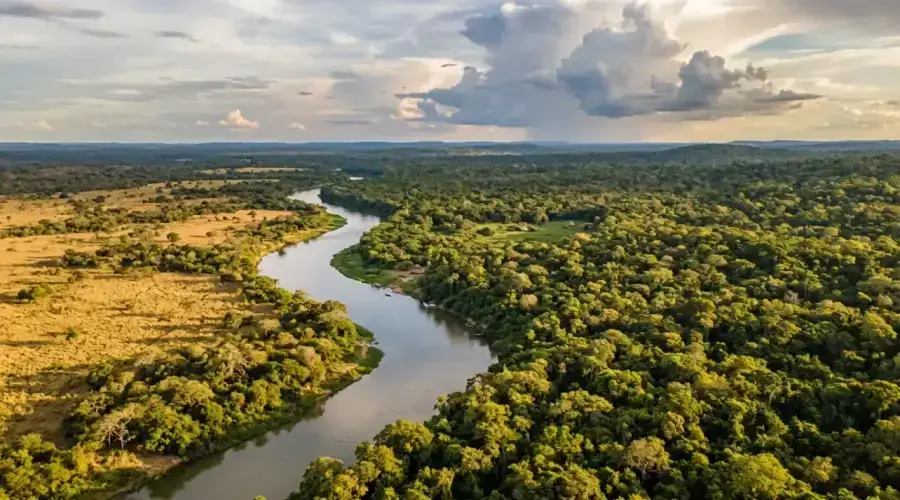
Paraguay is one of the richest natural meeting points in South America. Five ecoregions intersect here: threatened forests, immense wetlands and species that have become rare elsewhere. The country has something of a refuge, a crossroads and an ecological frontier. Species are distributed across highly contrasting environments: the dry Chaco, the Atlantic forest, the Pantanal, the savannas, the wetlands and the great rivers.
Jaguar, tagua and the giants of the Chaco
The Paraguayan Chaco is a world apart. Dry, vast, often scorching, it nonetheless shelters some of the country's most impressive species. The jaguar remains the great symbol of wildlife there, although its populations are scarce and highly fragmented (about 200 individuals). In this harsh landscape also live the tagua, the giant anteater, the giant armadillo, the capybara and, in certain areas, the guanaco.
The tagua is one of the most astonishing cases in all South American fauna. First discovered as a fossil in 1930, identified alive only in 1975, it alone gives an idea of the still partially unknown character of the Chaco. The giant anteater, with its 60 cm tongue and 30,000 ants per day, reminds us how adapted Paraguay's ecosystems can be to extreme conditions. The giant armadillo digs burrows 5 m deep.
- 1Jaguar: great feline, ~200 individuals in Paraguay
- 2Tagua: Chaco peccary, fossil turned living
- 3Giant anteater: 60 cm tongue, 30,000 ants/day
- 4Giant armadillo: burrows 5 m deep
- 5Capybara: 50 kg, present in all wetlands
The Atlantic forest BAAPA: a disappearing world
The Upper Parana Atlantic Forest (BAAPA) is one of the most threatened ecosystems in Paraguay. 90% of its surface has disappeared due to the combined effect of agriculture, grazing and habitat fragmentation. Yet what remains is still immensely rich. The Mbaracayu reserve (64,406 ha, UNESCO Biosphere Reserve) is its largest refuge.
There, the forest retains a spectacular verticality: canopy of 30-40 m, ancient trees (cedar, lapacho, yvyra pyta), lianas, orchids, bromeliads. Species that have become rare elsewhere in the country are found: giant otter (1.8 m, endangered), black howler monkey (howls that carry 3 km). The forest hosts 1,269 plant species, 440 birds, 93 mammals.
BAAPA concentrates dense but fragmented biodiversity. The country preserves fragments of a great continental forest, but its survival depends on constant vigilance.
700 bird species, a little-known paradise
Paraguay has more than 700 bird species recorded. The wetlands, residual forests and great rivers make it a territory of migration, stopover and reproduction, still little known internationally.
The jabiru (1.5 m tall, 3 m wingspan) is one of the great silhouettes of this avian landscape. The roseate spoonbill, the scarlet ibis, the cocoi heron, the toucans, the jacamars compose a picture of great visual richness. In the dry Chaco, the rhea (25 kg) moves in groups of 10 to 30. North American migrants arrive in September and leave in March.
- 1Mbaracayu: 440 species, Atlantic forest
- 2San Rafael: 427 species, humid forest
- 3Defensores del Chaco: 350 species, dry Chaco
- 4Paraguayan Pantanal: wetlands, jabirus, spoonbills
- 5Lake Ypacarai: water birds, accessible from Asuncion
Pantanal, reptiles and flora
The Paraguayan Pantanal (50,000 km2, RAMSAR site since 2015) is one of the country's great wetland complexes. It belongs to a gigantic wetland system shared with Brazil, where water, season and fauna impose their own rhythm. 80% flooded in the rainy season, it shelters the maned wolf, the marsh deer, the yacare caiman (up to 3 m) and the yellow anaconda (3-4 m).
Paraguay has 170 reptiles, 70 amphibians and 300 freshwater fish. The surubi can reach 100 kg. The flora is equally rich. The quebracho, emblematic tree of the Chaco, was exploited for decades for its tannin. The lapacho, national tree, blooms pink in August-September. Yerba mate connects the natural world with daily Paraguayan culture.
The Pantanal and the great rivers structure Paraguayan habitats through water. It shapes species and connects the country to broader regional dynamics.
Biodiversity in fragile balance
Paraguay's natural wealth is immense, but remains under pressure. Deforestation, agricultural expansion, habitat fragmentation and climate change affect several regions, particularly the Atlantic forest and certain areas of the Chaco. The country still possesses important spaces, but often isolated from one another.
Protecting species means maintaining ecological continuities, corridors, refuges and possibilities for wildlife movement. Paraguay is at an important moment: it could become a very strong conservation country if it manages to protect its great natural complexes while reconciling development and preservation.
What this says about Paraguay
From the Chaco to the Atlantic forests, from the Pantanal marshes to the banks of the Parana, Paraguay brings together five ecoregions in a territory of uncommon ecological diversity. This diversity gives it an identity of contrasts, resistance and discretion.
Last updated:
Sources
- UNESCO - Paraguayan Pantanal
- Moises Bertoni Foundation - Mbaracayu Reserve
- Conservation Status of Atlantic Forest Birds of Paraguay (2019) (2019)
- Asuncion Botanical Garden and Zoo - Wildlife refuge
- Guyra Paraguay - Bird conservation
- IUCN - Species of Paraguay
- WWF - Atlantic forest ecoregion
- BirdLife International - Paraguay
My method
This page is written from France, sourced as carefully as possible, but I can be wrong or miss on-the-ground detail. A price that changed, outdated info, a photo to share? Every correction is credited if you want.
Report an error or send info →Share