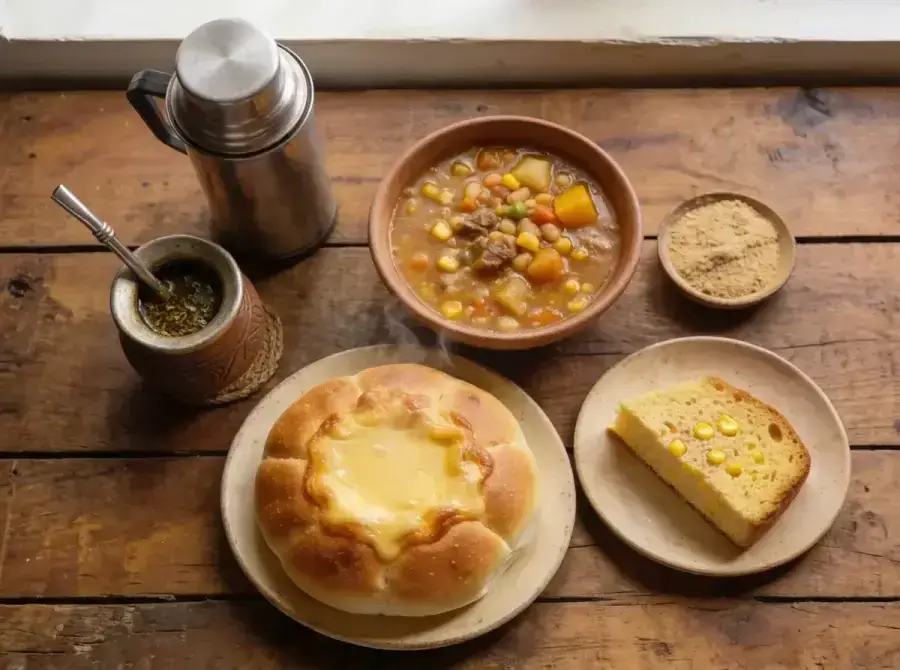
Paraguayan cuisine is a good gateway to understanding the country. Corn, manioc, cheese, meat, herbs, wood fire, sharing: each dish tells a story of Guarani and Hispanic mixing, of families, of seasons and of gestures passed down without instruction manuals. Sopa paraguaya is not a soup, chipa is eaten at any hour, tereré is a social ritual. This cuisine is concrete, nourishing and identity-defining.
Sopa paraguaya, the most famous false friend in the country
Sopa paraguaya is the country's most famous dish, and one of the worst-named. It is a dense savory cake, golden, tender inside and slightly crispy on top. It contains corn flour, onion, eggs, milk and above all Paraguay cheese, that local cheese which gives it all its melting and rounded character.
The best-known legend has it that a cook accidentally thickened a soup intended for President Carlos Antonio Lopez, turning the mishap into a specialty. Whether true or not, the story says that Paraguayan cuisine turns the unexpected into tradition. Every family keeps its own proportions and its way of achieving the right texture.
Chipa, the bread that accompanies everything
Chipa is everywhere. At the stations, in the markets, outside churches, in morning baskets, on bus platforms. This small round or ring-shaped bread, made from manioc starch, cheese, eggs and sometimes anise, is part of Paraguayan daily life to the point of being almost a cultural reflex. Its slightly firm crust hides a tender interior, sometimes very elastic depending on the recipe.
- 1Chipa so'o: with minced meat
- 2Chipa guasu: made with fresh corn kernels
- 3Chipa avati: with corn flour
- 4Chipa cabure: more cooked, more concentrated in flavor
- 5Chipa mestizo: mix of manioc and corn
Chipa also tells of the country's mobility: it is bought for the journey, eaten standing up, given as a gift, saved for later.
Mbeju, vori-vori and Paraguay's corn cooking
Mbeju is one of the country's unassuming specialties. This biscuit made from manioc starch and cheese is cooked to be crispy on the outside, melting on the inside, quiet in its simplicity. It shows what Paraguay knows how to do: dense, nourishing, without exaggeration. Vori-vori belongs to the same family: a thick soup with small corn and cheese dumplings, often served with chicken. Soyo, rarer, recalls a subsistence-style cooking.
Manioc, here, is a dietary staple. It takes the place of bread as found elsewhere, with an even stronger presence in local culture.
Tereré and mate: the water that circulates
Tereré in Paraguay is much more than a drink. It is a social gesture, a way of meeting up, taking a break and sharing a single vessel in a circle. Served cold, with yerba mate and medicinal herbs, it accompanies daily life. The herbs vary according to need: mint for freshness, lemon verbena for digestion, burrito for the stomach.
Mate, on the other hand, belongs more to quiet moments, to mornings, to winter. Together, they mark the rhythm of daily life. 90% of Paraguayans drink tereré; each person consumes 6 kg of yerba per year.
Asado, Sunday and the wood fire
In Paraguay, asado is a serious matter. It is a meal, a family staging and a Sunday ritual around the fire. Beef holds a central place: the country is the 6th largest exporter worldwide, each person consumes 40 kg per year. What distinguishes Paraguayan asado is the fire made from hard wood (quebracho, urunday), which gives a more aromatic smoke and deeper cooking.
Sunday midday becomes a moment of collective organization. Someone prepares the fire, another handles the meat, another accompanies with sopa paraguaya, manioc and salad. People talk, wait, watch, share.
| The most beloved cuts | |
|---|---|
| Costilla | Beef ribs, the king cut |
| Chorizo | Grilled pork sausage |
| Morcilla | Paraguayan blood sausage |
| Chinchulin | Grilled intestine, crispy |
| Vacio | Tender and juicy flank cut |
Markets, street food and popular cuisine
Paraguayan cuisine lives in homes as much as on the street, in markets, rotisseries and small neighborhood stalls. Mercado 4 in Asuncion is an example: a dense and popular place, where you taste the city through its dishes. Meat empanadas, pastel mandi'o, choriqueso, pacumutu or tropical fruit juices: a local cuisine, simple and effective.
- 1Meat empanada: filled pastry
- 2Pastel mandi'o: stuffed manioc fritter
- 3Choriqueso: chorizo sandwich with melted cheese
- 4Pacumutu: grilled fish in banana leaf
- 5Fresh juice: tropical fruits, just cents
Desserts, customs and regional variations
Paraguay has its sweets, less famous than its savory dishes. Kiveve, made from pumpkin and milk, is one of the popular desserts. Mazamorra, more rustic, recalls a corn culture present even in sweet preparations.
Eating habits follow the day's rhythm: light breakfast, hearty lunch between 12 and 2 PM, light dinner. In between, the tereré break is untouchable. Vegetarians get by with mbeju, sopa paraguaya, chipa and vori-vori without chicken. Outside the big cities, cooking remains centered on meat and local products.
- 1Share before serving
- 2Respect the tereré break
- 3Accept the guampa that is offered
- 4Eat together or don't eat at all
What Paraguayan cuisine reveals
Paraguayan cuisine is coherent, alive and local. It has preserved a Guarani base while integrating Hispanic contributions. It tells of a country of families, markets and sharing.
- 1Sopa paraguaya: the false national soup
- 2Chipa: the road bread
- 3Mbeju: the unassuming biscuit
- 4Vori-vori: the comforting soup
- 5Tereré: the ritual that connects
- 6Asado: the Sunday fire
Last updated:
Sources
My method
This page is written from France, sourced as carefully as possible, but I can be wrong or miss on-the-ground detail. A price that changed, outdated info, a photo to share? Every correction is credited if you want.
Report an error or send info →Share