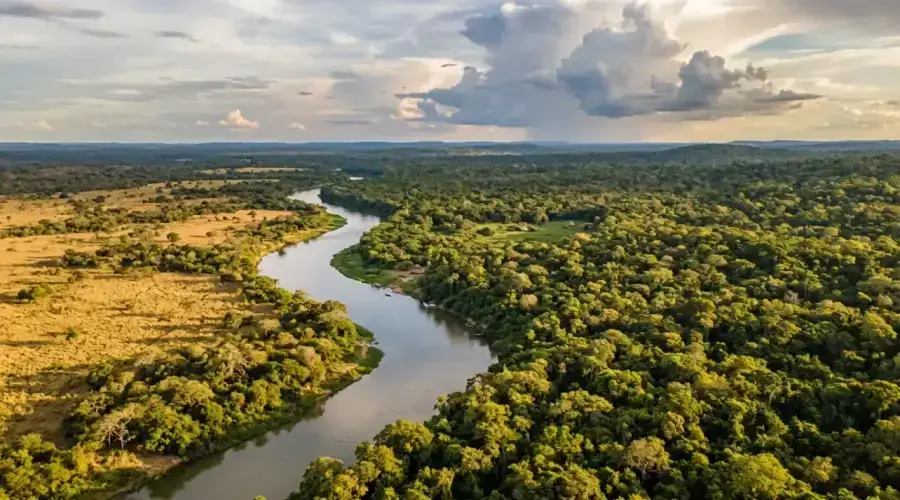

Encarnación is one of the most complete destinations in Paraguay: a city that concentrates several faces of the country without favoring just one. In a few days, you can go from a walk along the waterfront to a sunset over the river, from the ruins of Trinidad to a carnival night, from a local museum to the crossing into Argentina. For a long time perceived as secondary, Encarnación has changed its image. It has become the great summer city of Paraguay, the one with river beaches, families on the waterfront and popular gatherings in February. But it is also a historical hub, in the heart of Itapúa, a short distance from the country's two most famous Jesuit sites, declared UNESCO World Heritage. The combination of pleasant city, riverfront, world heritage, festive life and international connection makes Encarnación a rare destination for discovering Southern Paraguay.
Why Encarnación is so important in the Paraguayan landscape

Encarnación is a large city of the South and one of the few places in Paraguay where several of the country's logics become immediately legible. First, the fluvial logic: the city faces Posadas, in Argentina, and the Paraná is a structuring presence. Second, the regional logic: Encarnación is an urban, commercial and communications center in southeastern Paraguay. Finally, the cultural logic: the city is the natural access to the country's most prestigious Jesuit heritage.
Britannica describes it as an active commercial, manufacturing and communications center, processing timber, yerba mate, tobacco, cotton, corn, rice and livestock from the interior. This fact is useful: it reminds us that Encarnación was not born as a recreation station. Its role in the territory predates its current tourist staging. The city has something quite rare: a pleasant destination that rests on a real city. You discover a regional center that has beautified itself, opened up to the river and reconfigured itself, while maintaining an important economic and social function.
A city on the Paraná between memory, border and transformation

Britannica confirms that Encarnación was founded in 1614 on the western bank of the Upper Paraná, facing Posadas. The city has undergone major ruptures. Britannica notes that it was severely affected by a tornado in 1926. This episode gives depth to a city often told only through its tourist present.
The relationship with Argentina is part of its daily identity. Encarnación looks toward Posadas across the river, and both cities form an active border pair. A bridge completed in 1990 connects the two banks. In practice, this proximity transforms the experience of the city: Encarnación is a threshold between Paraguay and Argentina. You feel the country, but also the opening toward another rhythm, another market, another circulation.
The most visible mutation is more recent: the urban opening toward the river. Encarnación long revolved around its commercial, administrative and regional functions. Today, its waterfront, its beaches and its public spaces give it another air. The city has learned to show itself. It remains useful, but has become desirable. Rather than presenting it as the city facing Posadas, it should be seen as a city that reconquered its river. This idea connects the waterfront, the beaches, the evening strolls, urban social life and the transformation of the landscape.
The Encarnación carnival
The Encarnación carnival is the most famous in Paraguay and one of the great identity markers of the city. It is an event that goes beyond mere tourist entertainment: it organizes part of the local calendar, mobilizes clubs, comparsas, costume makers, rehearsals, families and a genuine culture of participation. Five nights of parades with monumental floats, sequin and feather costumes, samba schools and a sambadrome on the waterfront. Attendance reaches several tens of thousands of spectators each year, drawn from across the country and neighboring countries.
The carnival organizes part of the city's life. Encarnación then becomes a popular theater. Neighborhoods recognize themselves in their groups, preparation lasts months, and the event acts as a moment of local pride. The carnival says something important about the city: it knows how to stage itself. It gives Encarnación a national identity of its own, concentrates the festive image of Southern Paraguay, attracts visitors who would not have come only for the heritage, and perfectly complements the cultural offering of the nearby missions.
The waterfront and the beaches of the Paraná

One of the great advantages of Encarnación is its very direct relationship with the river. The 14-kilometer waterfront and the three developed beaches, San José, Mboi Ka'e and Pacu Cuá, form an efficient structure. The uses, atmospheres and differences between the places change everything.
The waterfront is a complete social space: you walk, run, bike, watch the river, gather with family, eat, wait for the night. This dimension of an open-air urban lounge makes the difference. Encarnación is much more organized around a public water front than most Paraguayan cities.
San José is the most well-known and lively beach. It attracts families, groups of friends, young people and part of the city's summer life. Mboi Ka'e is quieter, more relaxing, balancing the city's image. Pacu Cuá offers another face, more discreet, sometimes more natural. At night, Encarnación changes again. The river becomes a backdrop, restaurants take over, the stroll slows down, and the city gives that very South American feeling of public space truly lived in.
The best base for the Jesuit missions
This is undoubtedly the strongest argument for a cultural traveler. UNESCO confirms that the missions of La Santísima Trinidad de Paraná and Jesús de Tavarangue are located in the department of Itapúa, about 10 kilometers from each other. They represent two examples of 17th and 18th century Jesuit missions, and their urban organization, their layout and their fusion of indigenous elements and Christian symbolism make them key witnesses of the acculturation process in the Río de la Plata basin.
UNESCO describes Trinidad as the best preserved urban complex of the Paraguayan missions, with about 8 hectares including a large stone church, a small church, a college, a cloister, cemeteries, gardens, a bell tower, indigenous houses and workshops. Jesús de Tavarangue stands out for its archaeological character, its unfinished church and its particularly rare Mudéjar style in the former province of Paraguay.
- 1More comfortable than sleeping near the sites, wide hotel and dining offering
- 2Possibility to combine heritage, beach and nightlife
- 3Easy connection to Posadas for cross-border travelers
- 4Good starting point to explore Itapúa more broadly
Museums, urban memory and local heritage
Encarnación is not limited to its summer image. The city possesses an urban, industrial, religious and migrant memory worth telling. Among the places of local memory, several museums illuminate different layers of regional history.
- 1Museo Alberto Delvalle: Jesuit-Guarani art and regional history
- 2Museo de la Memoria Viva: industrial heritage, former San José mill
- 3Museo Nikkei: Japanese immigration in the region since the 1930s
- 4Santuario de la Virgen de Itacuá: regional pilgrimage, December 8
The religious dimension matters: the sanctuary of the Virgen de Itacuá is part of the regional spiritual geography and reminds us that Southern Paraguay is festive, heritage-oriented and still marked by religious rhythms. The migratory dimension also matters: Itapúa is a region of diverse origins, with European, Japanese and other communities settled over time. Encarnación greatly benefits from being told as a gateway to this plurality.
Local life, atmosphere and rhythm of the city

Encarnación is pleasant to live in for a few days. This quality is rare and worth highlighting. In the morning, the city can seem almost calm. Getting around happens without the tension of heavier metropolises. During the day, the heat and the river organize activities. In the late afternoon, the waterfront fills up, the light drops over the Paraná, families come out, groups gather and public space comes back to life.
This continuity between practical city and pleasant city is one of the true advantages of Encarnación. The proximity of Posadas also reinforces this feeling of circulation. You find yourself in an active border region. This gives the trip an additional density: passages, comings and goings, Argentine influence, commercial openness, contrasts of atmosphere.
What to do according to the length of stay
- 1In 1 day: waterfront, a beach, downtown, sunset over the Paraná, night by the water.
- 2In 2 days: day 1 city and waterfront, day 2 Trinidad + Jesús de Tavarangue.
- 3In 3 days: day 1 urban Encarnación, day 2 Jesuit missions, day 3 excursion to Itapúa or crossing to Posadas.
- 4In 4 days or more: add San Cosme and Damián, interior route of Itapúa, villages, local gastronomy, Argentine border depending on traveler profile.
Practical tips
| Useful information | |
|---|---|
| Getting there | 370 km from Asunción via route 1, 5 h by bus. Local airport. Paved road to Ciudad del Este. |
| Border | San Roque González de Santa Cruz bridge to Posadas (Argentina). Daily railway ferry. |
| When to go | February for carnival. Dec-Mar for the beaches. Mar-May and Aug-Nov for a balanced stay. |
| Budget | Affordable outside high season. Mid-range cost on the waterfront. Reservation required for carnival. |
| Where to sleep | Waterfront for atmosphere, downtown for practicality, quieter areas to explore Itapúa. |
- 1Getting around: taxis and local buses. Crossing to Posadas by railway ferry (10 min).
- 2Outside carnival: the city is still lively but much quieter. Better value for money.
- 3Combine: Encarnación + missions + Posadas = a complete cross-border circuit of 3-4 days.
Why Encarnación is one of the most underrated cities in Paraguay
Because it combines what many destinations separate. Nearby world heritage, a genuine regional city, a pleasant waterfront, a popular and festive dimension, international connection and an easy stay to organize. It offers an excellent gateway to Paraguay for a visitor who wants more than a capital or a purely natural circuit. Encarnación shows a less expected country: more open to the water, softer in its rhythm, more legible for the traveler, but without losing its historical depth.
Sources
My method
This page is written from France, sourced as carefully as possible, but I can be wrong or miss on-the-ground detail. A price that changed, outdated info, a photo to share? Every correction is credited if you want.
Report an error or send info →Share