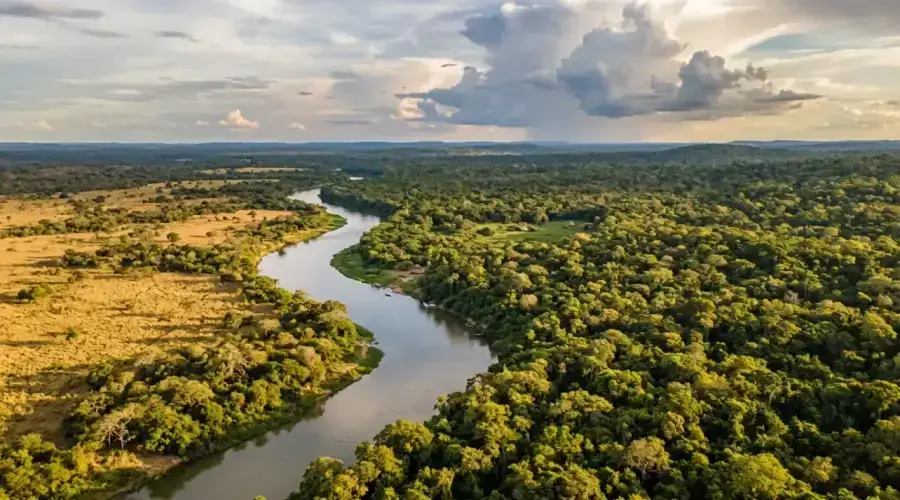

Paraguay is home to some of the richest and least visited ecosystems in South America, according to conservation organizations and naturalist guides. Inland Atlantic Forest (the most threatened in the world, with less than 15% of original cover remaining), Paraguayan Pantanal (wetland shared with Brazil and Bolivia), dry and humid Chaco: the country is a mosaic of biomes where biodiversity thrives. As tourism is infrequent, wildlife watching is usually done without the crowds of more famous sites.
The 8 reserves and parks not to be missed
At a glance
- •15 national parks and 38 protected areas covering 6% of the territory (IUCN 2023)
- •Mbaracayú (64,000 ha): last remnant of Atlantic Forest, managed by the Moisés Bertoni Foundation
- •Defensores del Chaco (720,000 ha, 7,200 km²): the largest national park, jaguar sanctuary
- •Paraguayan Pantanal: extension of the largest wetland system in the world
- •700+ bird species, 160 mammals, 250 reptiles and amphibians recorded
- •Dry season (May-September) ideal for wildlife watching
- •Budget for a naturalist guide ($30-50/day) to maximize sightings
Paraguay has 15 national parks and 38 protected areas covering approximately 6% of the territory (IUCN, 2023). Here are the 8 priority sites, selected for their accessibility, ecological interest, and quality of visitor experience.
An important thing to understand is that accessing these natural areas is not comparable to the experience offered by North American or Chilean parks. Infrastructure is minimal: trails are not always marked, interpretation panels are scarce, and reception is often limited to a ranger at the entrance who registers your visit and conscientiously tells you where to camp. This is both a limitation and an opportunity: this lack of infrastructure preserves total immersion. You won't hear the noise of tourist groups, but you might cross paths with a jaguar on the track.
| Parks and reserves comparison table | ||||||
|---|---|---|---|---|---|---|
| Mbaracayú | 64,000 ha | East | 4×4 recommended | Ecolodge $50/night | April-October | 2 € |
| Defensores del Chaco | 720,000 ha (7,200 km²) | North/Chaco | 4×4 mandatory | Camping | May-September | 2 € |
| Paraguayan Pantanal | ~100,000 ha | North | 4×4 mandatory | Bahía Negra Lodge | April-October | Free |
| Cerro Corá | 12,000 ha | Northeast | Regular vehicle | Camping | May-September | 1 € |
| Tinfunqué | 280,000 ha | Center | 4×4 recommended | Camping | April-September | 2 € |
| Ybycuí | 5,000 ha | South-Center | Regular vehicle | Camping | All year | 2 € |
| Atinguy | ~100 ha | South | Regular vehicle | N/A (half day) | All year | Free |
| San Rafael | 73,000 ha | Southeast | 4×4 recommended | Rustic camping | May-September | 1 € |
- 11. Reserva Mbaracayú (Este, 64.000 ha), último gran vestigio de bosque Atlántico interior en Paraguay. Gestionada conjuntamente por la Fundación Moisés Bertoni y las comunidades Aché, sus habitantes originarios. Observatorio del dosel a 20 m, 400+ especies de aves, jaguar, puma, tapir. Ecolodges comunitarios (Centro de Interpretación, 50 $/noche). Guía completa →
- 22. Defensores del Chaco National Park (North, 720,000 ha (7,200 km²)), the largest national park in the country. Sanctuary of the jaguar (Panthera onca), giant armadillo (Priodontes maximus), and rhea (Rhea americana). Landscapes of quebracho, cacti, and wooded savanna. Difficult access (4×4, 8h from Asunción), but exceptional reward.
- 33. Paraguayan Pantanal (North, Río Negro), northern extension of the largest wetland system in the world. Yacaré caimans, giant otters, hyacinth macaws, jabiru storks. Best season: April-October. Rustic lodges in Bahía Negra. Still almost unknown on tourist circuits.
- 44. Cerro Corá National Park (Northeast, 12,000 ha), forest and cerrado at the site of the last battle of the Triple Alliance (1870). Pre-Columbian cave paintings, howler monkeys, macaws. Marked hikes, camping allowed.
- 55. Tinfunqué Reserve (Center, 280,000 ha), wetland of the Pilcomayo basin. Ornithological paradise: ibis, herons, storks, flamingos on migration. Accessible from Asunción (4h drive). Best season: April-September.
- 66. Ybycuí National Park (South-Center, 5,000 ha), humid subtropical forest, waterfalls, marked trails. Former La Rosada iron foundry (1850), now a museum. Ideal for a first ecotourism experience (2h from Asunción).
- 77. Atinguy Reserve (South, ~100 ha), wetland adjacent to the Yacyretá dam. Bird observatory, interpretation center. Managed by the Yacyretá Binational Entity. Free access, easy from Ayolas.
- 88. San Rafael National Park (Southeast, 73,000 ha), high-altitude Atlantic Forest, one of the last jaguar refuges in the south of the country. Still little developed, reserved for motivated naturalists.
Emblematic wildlife: what you can observe
Paraguay is home to remarkably diverse wildlife for a landlocked country. According to IUCN and MADES, more than 700 bird species, 160 mammal species, and 250 reptile and amphibian species are recorded. Here are the star species and where to observe them.
Wildlife watching in Paraguay requires patience and discretion. Unlike African safaris, where animals are accustomed to vehicles, Paraguayan wildlife is elusive and discreet. The best times are dawn (5am-7am) and dusk (5pm-7pm), when animals come out to drink. An experienced naturalist guide makes all the difference: they know how to recognize a jaguar track in the mud, imitate the howler monkey's call, and spot a toucan hidden in the canopy. If traveling without a guide, favor natural water points in the dry season, around which wildlife concentrates.
| Emblematic species of Paraguay | |
|---|---|
| Jaguar (Panthera onca) | Defensores del Chaco, Mbaracayú, San Rafael. Nocturnal, elusive. Tracks frequent. |
| Hyacinth macaw (Anodorhynchus hyacinthinus) | Paraguayan Pantanal (Bahía Negra). The largest parrot in the world. |
| Giant armadillo (Priodontes maximus) | Dry Chaco. Largest armadillo, up to 60 kg. Vulnerable (IUCN). |
| Giant otter (Pteronura brasiliensis) | Pantanal, Río Negro. Endangered. Lives in family groups. |
| Rhea (Rhea americana) | Chaco. South American ostrich, ubiquitous on dirt roads. |
| Howler monkey (Alouatta caraya) | Forests of East and Center. Its call can be heard 5 km away. |
| Tapir (Tapirus terrestris) | Mbaracayú, Defensores. The largest terrestrial mammal in South America. |
| Toco toucan (Ramphastos toco) | Ubiquitous. Bright orange beak, emblematic. |
Threats and conservation: understand to visit better
Paraguay lost more than 85% of its original Atlantic Forest during the 20th century, mainly due to agricultural expansion (soy, cattle). Deforestation continues at a rate of 180,000 to 250,000 ha/year (Global Forest Watch, 2023), one of the highest rates in the world relative to remaining forest area. The Chaco is now on the front line: extensive cattle ranching and soy cultivation are reducing the dry forest.
The Moisés Bertoni Foundation, created in 1988, is the leading environmental NGO in Paraguay. It manages Mbaracayú, develops community ecotourism programs, and fights deforestation. MADES (Ministry of Environment and Sustainable Development) is the competent public authority. Guyra Paraguay (BirdLife International) coordinates ornithological monitoring and manages several private reserves.
The deforestation phenomenon in Paraguay is particularly visible along Route 6, linking Encarnación to Ciudad del Este. On this stretch, you see the Atlantic Forest disappearing in favor of soy plantations that extend as far as the eye can see. The figures are alarming: according to Global Forest Watch (2023), Paraguay lost 3.2 million hectares of primary forest since 2001, the equivalent of Belgium area. Adventure tourism and hiking in national parks are economic alternatives to deforestation: a hectare of protected forest generates more long-term income through ecotourism than a hectare converted to soy. This economic calculation, still little-known, is at the heart of conservation organizations advocacy.
Indigenous communities play a central role in the conservation of Paraguayan forests. The Aché, first inhabitants of the Atlantic Forest, co-manage the Mbaracayú reserve with the Moisés Bertoni Foundation. Their ancestral knowledge of the forest, medicinal plants, and wildlife cycles is integrated into research and tourism programs. In the Chaco, the Ayoreo and Ishir fight for the preservation of their ancestral territories against cattle ranching expansion. Visiting a reserve managed by indigenous communities directly supports their economic autonomy and their ability to protect their lands. The Museo del Barro and the Moisés Bertoni Foundation offer documentaries and exhibitions presenting the work of these communities.
Practical tips for responsible ecotourism
Practicing ecotourism in Paraguay requires good preparation and a respectful attitude. Here are the essential points to know before setting off.
- 1Seasonality: prefer the dry season (May-September). Tracks are passable, wildlife concentrates near water points, and mosquitoes are less aggressive.
- 2Guides: mandatory in most reserves. Local naturalist guides are trained by the Moisés Bertoni Foundation or Guyra Paraguay. Budget $30-50/day.
- 3Gear: binoculars essential, hiking shoes, long clothing (mosquitoes in wet season), headlamp, repellent, sunscreen.
- 4Accommodation: community lodges in Mbaracayú, camping in national parks, estancias in the Chaco. Little infrastructure: comfort is rustic.
- 5Respect: take nothing, stay on trails, don't feed animals, take all trash away, respect indigenous communities and their territory.
A little-known point concerns photography in reserves. While personal photos are of course allowed, drone use is strictly regulated, and even prohibited in national parks without prior MADES authorization. Indigenous communities (Aché in Mbaracayú, Ayoreo in the Chaco) also ask for explicit permission before any photography of their members or villages. When in doubt, always ask: a smile and a few words of Spanish are enough to build trust.
Finally, be aware that access to toilets and drinking water points is very limited in the parks. Each visitor must bring their own water (4 L/day recommended in the tropics), food, and a trash bag to take their waste away. Park rangers, often few and under-equipped, do remarkable work but cannot handle visitor waste management. The rule is simple: what you bring, you take away.
Last updated:
Sources
- Moisés Bertoni Foundation, Mbaracayú Reserve (2024)
- IUCN, Protected Areas of Paraguay (2023)
- Global Forest Watch, Paraguay Dashboard (2023)
- Guyra Paraguay, BirdLife International (2024)
- MADES, Ministry of Environment Paraguay
- Encyclopædia Britannica, Paraguay / Plant and Animal Life (2024)
- Welcome to Paraguay, Ecotourism
My method
This page is written from France, sourced as carefully as possible, but I can be wrong or miss on-the-ground detail. A price that changed, outdated info, a photo to share? Every correction is credited if you want.
Report an error or send info →Share