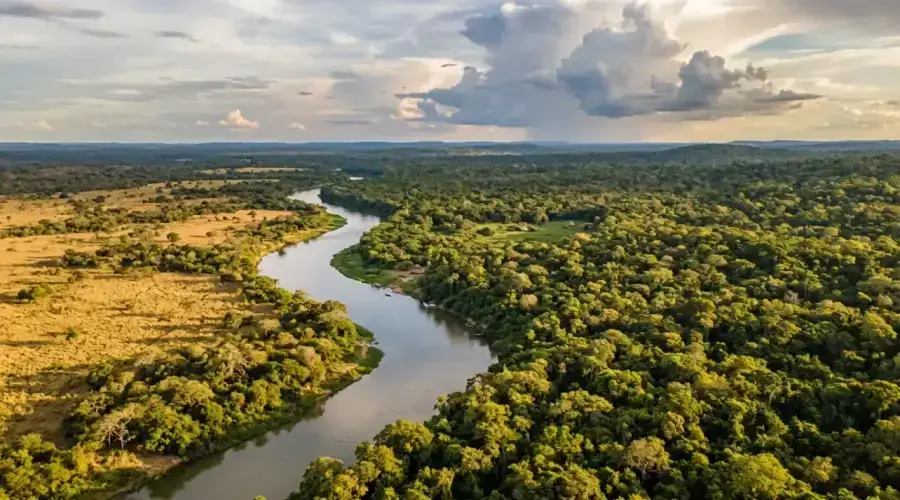

Defensores del Chaco National Park is, at 7,200 km², the largest protected area in Paraguay and one of the most extensive in South America. Created on August 6, 1975 by executive decree No. 16,806, it was designed both to preserve the dry Chaco ecosystem and to honor the memory of the veterans of the Chaco War, hence its name. In the center of this otherwise flat plain rises Cerro Leon, an isolated mountain formation 40 km in diameter, refuge of jaguars, pumas, tapirs, and giant anteaters. It is also one of the most demanding destinations in the country: access is difficult and remote, and should be arranged with a specialized operator rather than attempted spontaneously.
The largest protected area in the country
Created on August 6, 1975 by executive decree No. 16,806, Defensores del Chaco National Park covers approximately 7,200 km², making it by far the largest national park in Paraguay. Its initial objective was twofold: to conserve a representative sample of the dry Chaco ecoregion, its natural communities and landscapes, while honoring the memory of the veterans of the Chaco War (1932-1935), whose name the park bears. The site also houses the administrative headquarters of the Protected Areas Directorate of the Ministry of Environment and Sustainable Development (MADES).
Cerro Leon, a mountain in the middle of the plain
Cerro Leon is the park's most distinctive geographical feature: an isolated mountain formation approximately 40 kilometers in diameter, culminating at about 600 meters in altitude in the middle of an otherwise perfectly flat plain. This unexpected relief creates a microclimate and habitats different from the rest of the surrounding Chaco, which partly explains the site's faunal richness. The view from its summit at sunset is one of the most spectacular in the Paraguayan Chaco.
Emblematic and threatened wildlife
According to the park's 2017-2027 management plan, the area is home to approximately 70 species of mammals, 45% of the species recorded nationwide. Among the emblematic mammals are the jaguar (jaguarete), the puma, the tapir, as well as several species of anteaters and armadillos. This exceptional concentration of large mammals, rare on this scale in South America, makes the park a reference site for conservation, but also a particularly demanding place in terms of safety and logistics for visitors.
Practical tips
| Useful information | |
|---|---|
| Access | From Mariscal Estigarribia, several hours of dirt road; 4x4 essential, specialized operator highly recommended. |
| When to come | Dry season only (May-September): roads become impassable in the rainy season. |
| Equipment | Plenty of water, reserve fuel, satellite communication recommended due to lack of network coverage. |
| Combine with | Natural stop after Mariscal Estigarribia, for travelers preparing a complete Chaco circuit. |
Sources
My method
This page is written from France, sourced as carefully as possible, but I can be wrong or miss on-the-ground detail. A price that changed, outdated info, a photo to share? Every correction is credited if you want.
Report an error or send info →Share