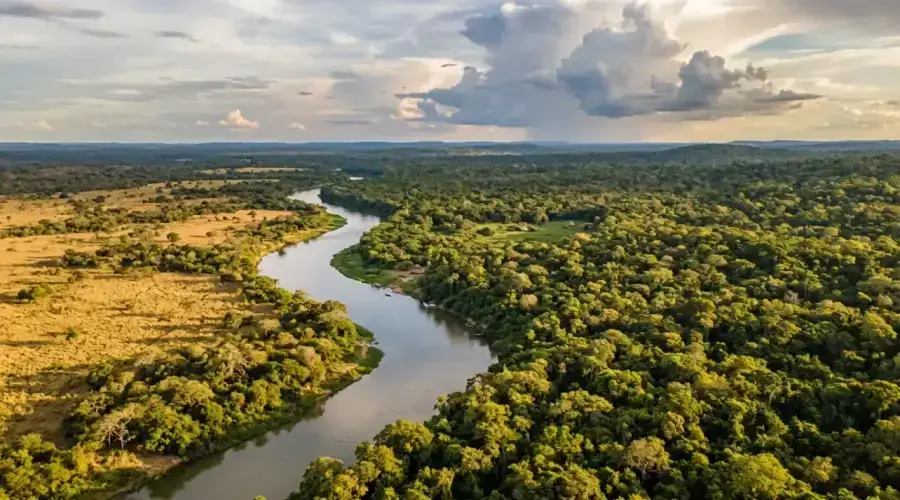
The Paraguayan economy recorded 5.8% year-on-year growth in the first quarter of 2026 according to the Central Bank of Paraguay, driven by agriculture, services, and construction. Real dynamism, but built on specific foundations: soybean agribusiness, hydroelectric energy from Itaipú and Yacyretá, and massive cross-border trade in Ciudad del Este. These are the engines behind this dynamism, and its fragilities.
Growth driven by agribusiness
The essentials
- •Paraguay is the 4th largest soybean exporter and 6th largest beef exporter worldwide, remarkable figures for 6 million inhabitants
- •Itaipú (14 GW) and Yacyretá (3.1 GW) make Paraguay the 1st per capita electricity exporter in the world
- •Ciudad del Este is the heart of border trade, with thousands of «paseros» crossing the Friendship Bridge daily
- •Territorial taxation (8-10% IRP on Paraguayan-source income only) attracts a growing number of foreign entrepreneurs
The Paraguayan economy recorded 5.8% year-on-year growth in the first quarter of 2026 according to the Central Bank of Paraguay, driven by agriculture, services, and construction. Real dynamism built on specific foundations: soybean agribusiness, hydroelectric energy from Itaipú and Yacyretá, and massive cross-border trade in Ciudad del Este.
Soybeans are the top export product, at around 10 billion dollars per year. Sugar cane, cassava, and sunflower complete the agricultural picture. Beef cattle farming, in recovery after several years of drought, benefits from favorable international prices. These sectors explain why Paraguay, with only 6 million inhabitants, ranks among the world's top exporters of several agricultural products.
| Major economic sectors | |||
|---|---|---|---|
| Soybeans | ~10 billion USD/year | 4th global exporter | 70% of production is exported, mainly to China, the EU, and Brazil |
| Beef | ~2 billion USD/year | 6th global exporter | Recovering from 2021-2022 droughts, 15 million head of cattle |
| Hydroelectricity | Itaipú (14 GW) + Yacyretá (3.1 GW) | 1st per capita exporter | Itaipú supplied 25,768 GWh to Paraguay in 2025, i.e. 78% of energy consumed |
| Border trade | Ciudad del Este | Major regional hub | Thousands of paseros cross daily, diversifying toward industry |
| Maquiladoras (Law 60/90) | ~30,000 jobs | Textiles, automotive assembly, electronics | Very favorable tax regime to produce in Paraguay and re-export |
Itaipú and Yacyretá: energy as strategic income
Hydroelectric dams are the second pillar of the Paraguayan economy, after agriculture. Itaipú, built binationally with Brazil and inaugurated in 1984, is the second largest dam in the world in annual production, with 14 GW of installed capacity. It supplied 25,768 GWh of electricity to Paraguay in 2025, a 26.4% increase from 2024, and represents around 78% of the energy consumed in the country.
Paraguay consumes only a fraction of its energy share and resells the surplus to Brazil at preferential rates set by the binational treaty. This resale is a significant source of income for the Paraguayan state, but is regularly questioned. Paraguayan authorities estimate that the current transfer price is well below market rates, making the renegotiation of the Itaipú treaty a recurring issue in foreign policy between Asunción and Brasília.
Ciudad del Este and the Triple Frontier: trade as an engine
Paraguay's second city with around 300,000 inhabitants, Ciudad del Este was built from the 1990s around cross-border trade with Brazil. The Friendship Bridge, connecting the city to Foz do Iguaçu on the Brazilian side, sees thousands of «paseros» (buyer-resellers) cross daily to make purchases they then resell in Brazil. This resale economy forged the city's reputation and also attracts Brazilian tourists seeking electronics, clothing, and cosmetics at reduced prices.
The image of Ciudad del Este is often associated with smuggling and informality. This is a reality, but only partial. Since the 2010s, the city is gradually diversifying toward manufacturing, regional logistics, and productive investment, driven by Law 60/90 on maquiladoras and the bioceanic corridor project that will connect the Chilean port of Antofagasta with the Brazilian port of Santos through the Paraguayan Chaco.
The Triple Frontier (Paraguay-Brazil-Argentina) is also a cultural space shaped by three countries. The three cities of Ciudad del Este, Foz do Iguaçu, and Puerto Iguazú form a conurbation of nearly one million inhabitants where Arab, Chinese, Brazilian, and Paraguayan merchants mix. See also the page Ciudad del Este for practical visiting tips.
One of the lightest tax burdens on the continent
Paraguay applies a principle of territorial taxation: only Paraguayan-source income is taxed. Foreign income (pensions, dividends, rents) is not taxed in Paraguay. For individuals, the income tax (IRP) applies at a rate of 8 to 10% only on income generated within the country. This light tax burden attracts a growing number of entrepreneurs, retirees, and foreign investors.
An important aspect to understand: there is no threshold of physical presence to become a tax resident in Paraguay. Unlike other countries where you must spend a certain number of days per year in the territory, Paraguayan tax residency is obtained through a separate administrative procedure. This topic is detailed on the page expatriation formalities. VAT is 10% on most goods and services, with a reduced rate of 5% for certain essential products.
| Tax comparison: Paraguay vs neighbors | |||
|---|---|---|---|
| Paraguay | Argentina | Brazil | |
| Income tax (IRP) | 8-10% | 35% | 30% |
| VAT | 10% | 21% | 21% |
| Tax on foreign income | 0% (territoriality) | worldwide | worldwide |
| Property tax | ~1% of market value | ~2% | ~1.5% |
Challenges: informality and dependence on raw materials
The Paraguayan economy faces several structural fragilities. The first is informality: according to the International Labour Organization (ILO), informal employment represents about 65% of non-agricultural employment. Street markets, street vendors, cross-border resale, and family micro-workshops constitute a considerable part of daily economic life. For travelers, this means that a large part of purchases (handicrafts, food, local transport) goes through undeclared channels. This is not a problem in itself for a tourist, but it gives an idea of the contrast between the official and the real economy.
The second fragility is dependence on raw materials and climate cycles. Droughts directly affect soybean production and cattle farming, with repercussions across the entire economy. Poverty has certainly declined sharply in the last twenty years (from over 50% to around 16% of the population according to the World Bank), but inequalities between rural and urban areas remain marked. The Chaco, which represents 60% of the territory, concentrates less than 2% of the population and a minimal share of economic activity.
- 1A significant part of the economy remains informal, particularly in border trade and family farming, complicating tax collection and social protection
- 2Growth remains sensitive to climate cycles (droughts affecting soybeans and cattle farming) and global commodity prices, two factors over which the country has little control
- 3Poverty has declined sharply in the last twenty years (from over 50% to around 16% of the population), but inequalities between rural and urban areas remain marked
- 4Maquiladoras and the emergence of a local tech scene (fintech, agritech) offer diversification prospects, but these sectors remain modest in job volume
The Guaraní, a stable currency but little traded internationally
The Paraguayan guaraní (PYG) is administered by the Central Bank of Paraguay and floats freely on the foreign exchange market. It is a historically stable currency for the region, with inflation between 4 and 6% in recent years, far from the hyperinflationary crises suffered by Argentina or Bolivia. This relative stability is an advantage for the economy and for travelers, who do not have to fear sharp exchange rate fluctuations during their stay.
However, the guaraní is a currency little traded outside Paraguay. European banks and exchange offices generally do not offer guaraníes. Travelers must therefore exchange their euros or dollars on the ground, once they arrive in Paraguay. US dollars are accepted in many tourist establishments and hotels, but the guaraní remains king for everyday transactions (markets, transport, small shops). See details on the money exchange page for good exchange practices.
Last updated:
Sources
My method
This page is written from France, sourced as carefully as possible, but I can be wrong or miss on-the-ground detail. A price that changed, outdated info, a photo to share? Every correction is credited if you want.
Report an error or send info →Share