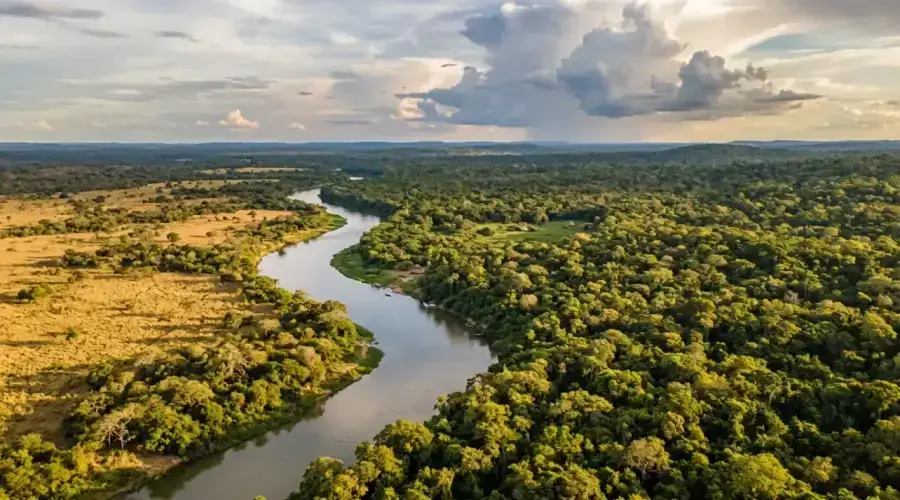

San Ignacio Guazú is the first Jesuit reduction founded in Paraguay, on December 29, 1609, by the priests Marcial de Lorenzana and Francisco de San Martín with the cacique Arapysandú. It is the place of origin of a great Paraguayan story: that of the missions, Jesuit-Guarani art, living religious memory and the spectacular Tañarandy Holy Week. Its strength lies elsewhere than in the archaeological monumentality of Trinidad or the unfinished silhouette of Jesús. San Ignacio is a city of foundation, continuity and active memory. Here, the history of the missions continued in objects, practices, a religious imaginary, and even in the contemporary relationship with art. The diocesan museum preserves its polychrome wood statues, and Tañarandy attracts visitors each year during Holy Week.
Why San Ignacio Guazú is a foundational place

San Ignacio Guazú deserves special treatment because it is not a simple point of interest among others. It is an origin. A matrix. Historical documentation confirms that Marcial de Lorenzana and Francisco de San Martín were guided to the site by the cacique Arapysandú, that an altar was erected and that the first mass was celebrated on December 29, 1609. The mission was then officially organized and structured in early 1610, especially by Roque González de Santa Cruz, becoming a reference center for the Jesuit reductions of Paraguay.
The word Guazú means big in Guarani, which serves to distinguish this mission from other San Ignacio missions in the missionary world, particularly San Ignacio Miní in Argentina. This detail reminds us of the extent to which the Jesuit geography of the Río de la Plata formed a vast cross-border network where names circulated and responded to each other. You can visit Trinidad for the stone, Jesús de Tavarangue for the unfinished, but San Ignacio for the source. Here, in the early 17th century, the Paraguayan Jesuit-Guarani experience began.
The first Jesuit reduction in Paraguay
The history of San Ignacio Guazú must be told as a threshold. In 1609, the experience of reductions began here in present-day Paraguay. The Jesuits wanted to gather populations, teach, evangelize and protect indigenous communities from certain forms of colonial exploitation. The reductions were organized communities, structured around a religious center, an urban space, workshops, places of teaching and strong social framing.
The place very quickly became a reference center. It opened a historical route that led to other missions in Southern Paraguay, and then to a much vaster network in the Río de la Plata basin. San Ignacio possesses an anteriority and a foundational depth that no other Paraguayan city can claim in the same way. The city is not visited as a pure archaeological site. It is read differently: in its museum, in its religious heritage, in its artistic vocabulary, in its cultural practices and in the very fabric of the city.
The diocesan museum of Jesuit-Guarani art

The heritage heart of the city today is its diocesan museum. It is installed in the former indigenous college from the Jesuit era and preserves polychrome wood sculptures made by the Guarani in the 17th century. It is not a small local museum put together late. It is a space directly linked to the missionary world, housing works produced in this context. The museum displays about thirty polychrome wood statues distributed by theme: the Hispanic-Guarani Baroque carved by the Guarani in the 17th century.
The objects are distributed across four themed rooms that follow a true narrative: Creation, Redemption, the History of Christ in the Church and the History of the Society of Jesus. This structuring shows that the visit follows a narrative and not a simple placement of objects. The place guides the visitor through a visual theology, but also through a history of the mission itself. Entrance costs 20 000 Gs (~3 €). Hours may vary by season. Generally, it opens in the morning and afternoon, with a break at midday. It is prudent to check before traveling.
What the sacred art of San Ignacio reveals
The sculptures are religious objects that also carry the material trace of a missionary world where the Guarani learned, transformed, adapted and transmitted European forms in a local framework. The faces often strike more: angels with mestizo faces, saints with indigenous features, Virgins with a Guarani gaze. This art is not a simple extension of Europe in the tropics. It is a cultural translation. The Hispanic-Guarani Baroque is carved by the Guarani, in a very particular missionary framework, associating catechesis, crafts, sacred theater and image.
The museum is also a living museum. Local youth receive classes there in wood carving, painting and singing. This information changes the interpretation of the place: heritage lives beyond the display cases, in learning gestures. The past is not frozen. Transmission continues. San Ignacio does more than archive an art: it still makes it breathe.
Tañarandy and Holy Week

The second great reason to come to San Ignacio Guazú is Tañarandy (in Guarani: devil's land). This neighborhood has become famous for its Holy Week celebrations, which attract thousands of visitors each year. Torchlight processions, living stations of the cross, biblical scenes recreated by the inhabitants, street theater, sacred art and local traditions: popular fervor is expressed in a rural and nocturnal setting of great intensity.
The event was created by the artist Koki Ruiz, a native of San Ignacio, and combines street theater, Baroque imagery and Guarani traditions. Tañarandy shows that San Ignacio is a city that reactivates the past, beyond merely preserving it. Religion becomes collective performance, scenography, embodied memory and artistic appropriation. This connects with the ancient missionary logic, where image, music, theater and rituality already held an essential place in transmission. Tañarandy is a form of cultural continuity, even transformed, between the religious aesthetic of the missions and a contemporary popular expression.
Artists, transmission and living heritage
San Ignacio Guazú is the guardian of a heritage and a place where artists and artisans prolong a tradition or reinterpret it. The sculptor Feliciano Centurión (1916-1995) spent his life carving saints in wood in the Jesuit-Guarani line, perpetuating a three-century gesture. He embodies the silent continuity of workshops, wood, slow gestures, a local heritage transmitted beyond global radars.
Koki Ruiz (born 1954) gives San Ignacio a more contemporary and more visible dimension. With Tañarandy, he showed that a religious and popular visual language could reinvent itself in public space, combining Baroque aesthetics, community memory and Paraguayan identity. He is a figure of mediation between the missionary past and current creation. In San Ignacio, the Jesuit-Guarani legacy does not sleep. It is seen in the museum, in sculpture and painting classes, in Holy Week, in local artists and in the importance given to visual memory.
What you feel in the city
San Ignacio Guazú has a very different atmosphere from Encarnación. Where Encarnación gives water, strolls and summer, San Ignacio gives moderation, province and long time. The rhythm is quieter, more inward, more conducive to a leisurely reading of the place. The fact that it is an inhabited city, not a simple archaeological site, produces a particular experience. You can walk, go to the museum, observe the churches and public spaces, and then feel that history is not always shown spectacularly.
It is a city of sedimentation. For many travelers, this may seem less immediate than Trinidad or Encarnación. In reality, it is the opposite: San Ignacio often becomes more important afterward. Once the mission route is finished, you understand that everything here made sense. San Ignacio is also one of the best examples of what Paraguay sometimes achieves most subtly: making very ancient memory coexist with very real local life.
How to integrate San Ignacio into a Southern itinerary
- 1On the way between Asunción and Encarnación: important cultural stop on the route to the South, about 3 h from Asunción.
- 2Complement to UNESCO sites: after Trinidad and Jesús, San Ignacio adds the museum, artistic and living side of the missionary world.
- 3During Holy Week: San Ignacio becomes a major event destination where faith, art and crowds transform the space.
- 4Base for Missions: explore the former missionary centers like Santa Rosa, Santiago or Santa María de Fe.
Practical information
| Key facts | |
|---|---|
| Access | 225 km from Asunción via route 1, ~3 h. Frequent buses from Asunción terminal |
| Museum | Former indigenous college. Hours vary by season. ~20 000 Gs |
| Holy Week | March-April, Tañarandy. Book accommodation well in advance |
| Accommodation | Hotels and inns in the city. Or a day trip through Itapúa-Misiones |
| Combine | Trinidad (108 km), Encarnación (110 km), Santa Rosa, Santiago, Santa María de Fe |
- 1Best season: March-May or September-November for mild weather. Holy Week for Tañarandy.
- 2Recommended duration: half a day for the museum and city. A full day for Tañarandy.
- 3Keep in mind: quiet and provincial city. Less touristy than the UNESCO sites. Plan your own transport to explore the surroundings.
Why San Ignacio is indispensable for understanding Paraguay
Because it brings together in one place several central dimensions of the country. Bilingualism and the underlying Guarani depth. The beginning of the Paraguayan Jesuit reductions. A religious art transformed locally. A memory that passes through both objects and festivals. A continuity between history, faith, image and contemporary creation.
San Ignacio forces us to look differently than the riverside strolls or the photogenic UNESCO sites. It teaches that the history of Paraguay is not understood only through major political events or spectacular landscapes. It is also understood in a museum room, in a saint carved in wood, in a nocturnal procession, in a city that has preserved the calm of its ancient layers.
Sources
My method
This page is written from France, sourced as carefully as possible, but I can be wrong or miss on-the-ground detail. A price that changed, outdated info, a photo to share? Every correction is credited if you want.
Report an error or send info →Share