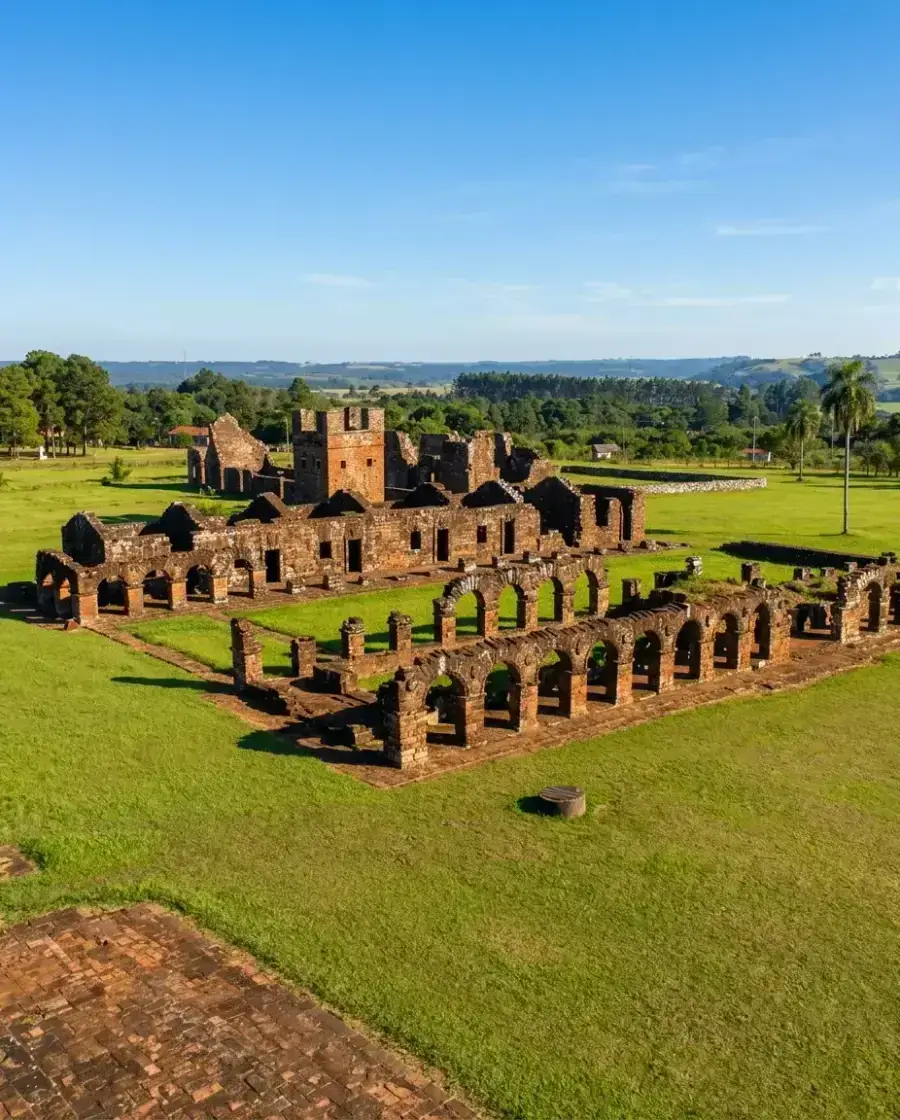

Southern Paraguay is a world-region. Water, Jesuit memory, the Argentine border, pilgrimages, carnival, wetlands, a fluvial gentleness. Between the Guarani baroque of UNESCO-listed missions and life along the Parana, between the dams and the marshes of Ñeembucu, the South tells Paraguay from its densest margins. I have gathered here what you need to know before going, from the Encarnacion waterfront to the ruins of Trinidad, from the docks of Ayolas to the marshes of Ñeembucu.
To remember about Southern Paraguay
- 1Two UNESCO sites (Trinidad and Jesus) accessible on the same day
- 2Encarnacion: 14 km waterfront, 3 beaches, carnival in February, gateway to the missions
- 3San Ignacio Guazu: first reduction (1609), diocesan museum, Tanarandy
- 4Pilar and Ñeembucu: 227 to 279 bird species, 8,000 km² wetlands
- 5Ayolas: Yacyreta binational dam (1973-1998), fishing, Atinguy reserve
A region of rivers, memory and borders
Southern Paraguay is first understood through geography. The Parana River forms a major border with Argentina and structures much of the mobility, economy and landscapes. Encarnacion faces Posadas across the water. Ayolas lives to the rhythm of Yacyreta. Further west, the country slides towards the Ñeembucu wetlands, to the confluences and amphibious spaces that already herald other fluvial worlds.
The South is also the space where the footprint of the Jesuit reductions is best perceived. The missions of La Santisima Trinidad del Parana and Jesus de Tavarangue belong to a much broader urban, religious, social and economic system developed in the 17th and 18th centuries in the Rio de la Plata basin. UNESCO emphasizes this dimension: these missions testify to an unprecedented process of acculturation, in which indigenous elements were maintained combined with Christian attributes and symbols, with Baroque, Romanesque and Greek influences.
The South is a region where ancient forms are still legible. Look past the stones and you see a city plan, an organization of space, workshops, orchards, plazas, cloisters, houses for indigenous inhabitants, schools and churches conceived as centers of a world. This legibility is the strength of the journey.
The Jesuit missions route
This is the great cultural axis of the South. Between 1609 and 1767, the Jesuits developed reductions in the region where the Guarani were grouped into communities organized according to a logic that was simultaneously religious, social, urban and productive. The official goal was to Christianize the native populations and protect them from the colonial encomienda system. But what was built on the ground far exceeds a simple missionary story.
The reductions follow a remarkable urban organization. The church forms the central core, surrounded by the priests' residence, the chieftains' houses, workshops, the garden, the cemetery, the prison, community spaces and a large plaza open to the four cardinal points. The streets radiate outward in width, and the indigenous housing blocks are structured in regular ensembles. This planned urbanity, associated with a strong preservation of certain Guarani cultural elements, makes the missions a historical object found nowhere else in South America.
Trinidad. The mission of La Santisima Trinidad del Parana is the best preserved and most ambitious in Paraguay. Founded in 1706, it covered approximately 8 hectares and constitutes, according to UNESCO, the best preserved urban complex of the Paraguayan network. The great stone church, designed around 1745 from plans by Milanese architect Juan Bautista Primoli, had a refined dome and a particularly impressive decoration. What remains is considerable: great church, small church, college, cloister, cemeteries, gardens, bell tower, indigenous houses and workshops. One does not visit a simple ruined site, but a space where the scale of a mission-city remains perceptible. Even without prior knowledge, you understand how life was organized.
Jesus de Tavarangue. A dozen kilometers from Trinidad, Jesus was founded in 1685 at another location before being moved to its current site. Its great singularity is architectural. The church remained unfinished, but presents a very rare mixture of styles, especially Mudéjar, visible in the use of the trefoil arch. UNESCO notes that there is no other regional example of this style, inherited from the Jesuit era in the former province of Paraguay. Jesus shows not the achieved plenitude of a whole, but a suspended architectural ambition.
San Ignacio Guazu. The first reduction founded in 1609 in Paraguay. Although its monumental vestiges do not produce the same visual effect as Trinidad, its historical importance is immense. This is where the Paraguayan missionary cycle truly begins. The diocesan museum and the atmosphere of the town allow you to approach the subject differently: through objects, sacred art and local memory.
Santa Rosa, Santiago and Santa Maria de Fe. These stops are less known to international travelers, and that is precisely their appeal. They allow you to step away from the obligatory UNESCO logic to discover another thickness of the South: that of small towns where Jesuit history is still urban, cultural and sometimes liturgical alongside the archaeology. Churches, museums, quiet plazas, handicrafts and religious practices here extend the memory of the reductions in a more everyday form.
Tanarandy, Holy Week and living memory. In the surroundings of San Ignacio, the celebration of Tanarandy during Holy Week is one of the most powerful moments of the region. Torchlit processions, penumbra aesthetics, popular religious art, silence and the staging of memory give the South a depth that goes beyond heritage tourism. Here, the region reactivates its past, going beyond simple preservation.
Encarnacion, river capital of the South
Encarnacion is often the first gateway to the South, and for many travelers the most surprising. It is an urban and river destination, often more remarkable than expected. Set on the northern bank of the Parana facing Posadas in Argentina, it combines waterfront, student life, summer rhythm, access to the ruins and carnival. Its waterfront, about 14 kilometers, gives the city a rare vitality in Paraguay. The developed beaches have transformed its image: Encarnacion is no longer just a logistics base, but a city for strolling, swimming, sunsets and summer.
The Encarnacion carnival is one of the major events of the country. It attracts a considerable crowd, mobilizes clubs, costumes, floats, rehearsals and an intense nightlife. On a regional itinerary, it completely changes the atmosphere: the same city that is the gateway to Trinidad becomes, for a few days, a giant popular theater. Encarnacion functions as a point of balance: ideal base for the missions, pleasant city for several nights, easy connection with Argentina, best access to the idea of the river South, good transition between heritage, leisure and logistics.
The Parana, a living border
In the South, the Parana is not a simple border line. It is a lived, inhabited, worked, crossed, watched and narrated space. It carries the cities, the dams, the fishing areas, the beaches and part of the regional imagination. Its role is both economic and symbolic. The river connects several temporalities. On one hand, it recalls the great historical circulations, the missionary settlements and the logic of the Rio de la Plata basin. On the other, it sustains today energy, exchanges, leisure and a very concrete border life.
The confluence of the Paraguay and the Parana, near Paso de Patria, adds another dimension to the region. It is a place of very powerful geography: where two great rivers articulate, the imaginaries of the border become even more intense. A cartographic point, but also an idea: that of a South that ends and begins in the water.
Ayolas, Yacyreta and the energy of the river
Ayolas introduces the traveler to another Paraguay: that of hydroelectricity, binational planning and major contemporary works. Yacyreta is one of the country's great dams, co-managed with Argentina. The plant tells the story of the transformation of a river into strategic infrastructure, the regional weight of Paraguayan energy and the country's capacity to make water a major geopolitical resource.
Ayolas is also a good base for exploring the surroundings, associated reserves, riverbanks, certain fishing areas and the very specific relationship that Misiones maintains with the transformed river.
Pilar and Ñeembucu, the South of slow waters
If Encarnacion represents the liveliest South, Pilar offers its quieter side. Situated on the Paraguay River, in the department of Ñeembucu, it opens onto a universe of wetlands, marshes, birds, fishing and horizontal landscapes. The region is one of the most interesting in the country for those who love off-the-beaten-path spaces, river nature and slow atmospheres.
Ñeembucu does not give up its charms immediately. It seduces through omnipresent water, the light, the flat horizons, the feeling of the edge of the inhabited world and the ornithological richness. Pilar can serve as a base for a more contemplative Paraguay, less about ticking sites, more regional. It is an excellent stop to balance a trip that might have started with the cultural intensity of the Jesuit route.
According to your tastes
| What you're looking for | |
|---|---|
| UNESCO and history | Trinidad, Jesus, San Ignacio |
| Summer and river life | Encarnacion, Waterfront, beaches |
| Major infrastructure | Ayolas, Yacyreta |
| Birds and slow water | Pilar, Ñeembucu |
| Holy Week | San Ignacio, Tanarandy |
| Off the beaten path | Santa Rosa, Santiago, Santa Maria de Fe |
When to go
| By season | |
|---|---|
| Jesuit missions | Mar-May or Sep-Nov: mild temperatures, ideal light |
| Encarnacion and beaches | Dec-Feb: warm season, carnival, large crowds |
| Ñeembucu birdwatching | May-Sep: dry season, best visibility |
| Tanarandy and Holy Week | Mar-Apr: popular fervor, book in advance |
Recommended itineraries
- 12 days (short version): day 1 Encarnacion + waterfront, day 2 Trinidad + Jesus de Tavarangue.
- 24 days (classic version): day 1 Encarnacion, day 2 Trinidad + Jesus, day 3 San Ignacio + Santa Rosa, day 4 Ayolas or return.
- 36-7 days (full version): Encarnacion and the missions, interior route of Misiones, Ayolas and Yacyreta, Pilar and Ñeembucu, slow return with regional stops.
- 4Culture + water: Encarnacion, Trinidad, Jesus, San Ignacio, Tanarandy if possible, Pilar at the end.
- 5More off the beaten path: Santa Rosa, Santa Maria de Fe, small museums, local markets, secondary riverbanks, wetlands.
What you will take away from the South
A finer understanding of Paraguay. The impression of a country built around water and memory. Images of red ruins, large empty plazas and sunsets over the river. A South more subtle than expected.
- 1Accessible and uncrowded UNESCO World Heritage
- 2Jesuit memory still legible in the stones and museums
- 3Lively river cities, from carnival to silent marshes
- 4Binational dam that tells the strategic weight of water
- 5Wetlands among the richest in the country for observation
- 6A region that synthesizes Paraguay without caricaturing it
Sources
My method
This page is written from France, sourced as carefully as possible, but I can be wrong or miss on-the-ground detail. A price that changed, outdated info, a photo to share? Every correction is credited if you want.
Report an error or send info →Share