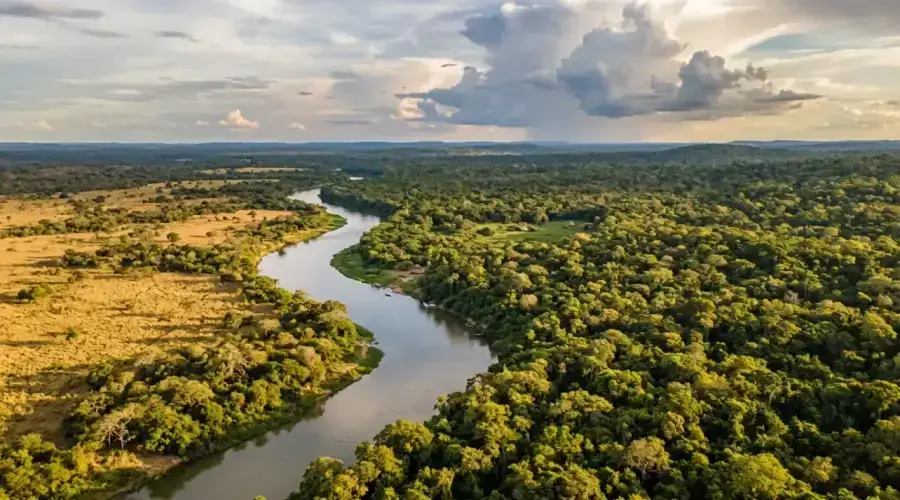

Pilar is one of the most discreet and endearing destinations in Southern Paraguay. You do not come for a world-famous monument or a spectacular urban scene. You come for a more horizontal, wetter, quieter Paraguay, where the river structures the days, where the lagoons attract birds, where history exists without crushing the landscape. Capital of the Ñeembucú department, Pilar combines an old fluvial role, a strong provincial identity, a still legible urban heritage and immediate proximity to one of the great wetland complexes of Paraguay. The traveler who arrives here after the mission route changes register: the heritage South gives way to a more liquid, more open South, more sensitive to seasons, lights and bird migrations.
Why Pilar matters in Southern Paraguay

Pilar is another Southern Paraguay different from the more famous one of Encarnación and the Jesuit missions. Here, the relationship with the territory passes above all through water. The Paraguay River structures the city, but around Pilar extend lagoons, marshes, wetlands and open landscapes that make Ñeembucú a major ecological space.
Britannica notes that Pilar is located on the eastern bank of the Paraguay River, opposite the mouth of the Arroyo Bermejo, and that it was founded in 1779, formerly known as Ñeembucú. It is a river port that processes agricultural products from the fertile zone between the Paraguay and Paraná rivers, and a manufacturing center with textile mills, sawmills and distilleries. This fact is useful: Pilar is not a recent invention of nature tourism. It is a genuine regional city with an old economic role.
A river city founded in 1779

The date of 1779 is solid: Britannica confirms that Pilar was founded that year and initially bore the name Ñeembucú. The city developed as a river port, in connection with the vast agricultural and humid space that surrounds it. Its location on the Paraguay explains many things: its trade, its uses, its openness, its relationship with seasonal rhythms and even its atmosphere.
A river city does not function like a dry road city or an agricultural plateau town. Time depends more on water circulations, fishing, boats, docks and changing landscapes. Pilar does not have the visual impact of a metropolis nor the monumental waterfront of a city transformed by a major urban operation. It remains simpler, more provincial, more legible. Its charm lies in this: a human scale that allows you to explore it without haste.
The city of birds and the Ñeembucú wetlands
Here is where Pilar becomes a strong destination. The Ñeembucú wetlands form a complex of about 8 000 km² that provides critical habitat for birdlife. A scientific study published through SciELO has recorded 227 bird species in the region, belonging to 182 genera, 54 families and 26 orders. Other conservation sources mention at least 279 species depending on the perimeters considered. Ñeembucú is one of the great ornithological territories of Paraguay.
The wetlands create a mosaic of habitats: lagoons, marshes, oxbows, floodable meadows, savannas and riparian forests. The diversity of habitats conditions the diversity of bird assemblages, with higher values in riparian forests and savannas. Among the emblematic species, conservation sources mention the jabiru, the roseate spoonbill, various herons, ibis, the rhea, parrots and raptors linked to open or humid environments.
Observation, nature and seasons
The true luxury of Pilar is that it allows relatively unsaturated nature observation. You are not in an ornithological destination turned into a major international circuit. Pilar retains a part of simplicity. The dry season, between May and September, remains the best window for observation. The waters recede, access can be simpler, and the relative concentration of fauna around certain water bodies facilitates sightings.
The department lends itself to morning outings, vehicle trips to certain lagoons, short boat rides and fixed observation points at dawn. Pilar appeals to birdwatchers for several reasons: the avian richness, the feeling of space, the horizontal landscapes and the southern light. The promise needs qualification: the wetlands demand patience, discretion and sometimes a bit of luck. The place rewards attention more than quick consumption.
River, sport fishing and fluvial tourism

The Paraguay River gives Pilar a second great vocation: fishing and water outings. The city is known for sport fishing, especially for dorado, a freshwater fish with spectacular fights, as well as surubí and pacú. Boat excursions allow exploring the river branches, the lagoons and the islets, and skirting the Paraguay-Paraná confluence at Paso de Patria, a key southern point of the country.
Fluvial tourism perfectly complements ornithology. The same stay can combine quiet navigation, birdwatching, guided fishing and discovery of the riverbanks. For those who do not fish, the presence of the river structures everything: the light, the air, the rhythm of sunsets and the feeling of openness. The Paraguay, in this place, is a liquid border and a space of use: fishing, local circulation, landscape observation and strategic memory.
Urban heritage, memory and history

The great mistake would be to present Pilar as a purely naturalist destination. The city possesses a real historical and urban depth. Britannica recalls its former role as a port and manufacturing center. Pilar has preserved a center with the Nuestra Señora del Pilar basilica, the old Cabildo and low houses with tiled roofs. The approach remains relevant: Pilar has maintained an image of an old provincial city, with a certain urban softness that contrasts with the more transformed poles of the country.
Pilar's heritage is not monumental on the scale of a grand colonial circuit. It is more intimate. You can appreciate the alignments of low houses, the atmosphere of the streets, the relationship between the urban center and the river, and the feeling of continuity. The textile factory Manufactura de Pilar, founded in 1930, recalls another face of the city: work, industry and local sociology alongside riverside contemplation.
Paso de Patria, Itapirú and the military depth of the South
This section connects Pilar with Paraguayan national history, especially the War of the Triple Alliance (1864-1870). The forts of Paso de Patria and Itapirú, located about thirty kilometers away, were key positions. The interest is above all narrative: Pilar is more than birds and marshes: it lies in a space where fluvial geography had major strategic weight.
The confluences, the riverbanks, the fortins and the waterways had military importance. This gives the destination an additional depth and avoids reducing it to mere slow tourism. Southern Paraguay is never only gentle. It also carries a memory of war, control of rivers and defensive positions.
The atmosphere of Pilar day by day
Pilar has a tempo of its own. The city does not need a permanent event to exist. It sustains itself through its relationship with space, air, the river and its humid surroundings. In the morning, the light over the Paraguay sets the tone. The day organizes without excessive precipitation. Nature outings depart early. The hot hours slow down movement. At sunset, the city recovers another rhythm, more social, more strolling.
A destination that gains from being lived in slow sequences rather than a checklist. You feel good thanks to the human scale, the relative absence of tourist saturation, the strong presence of the landscapes, the possibility of alternating city, water and nature. Pilar does not have the brilliance of Encarnación nor the symbolic density of the missions. Instead, it possesses a rare coherence: an intimate relationship between city and wetlands.
How to organize a stay in Pilar
- 1In 1 day: center, riverfront, first reading of the landscape, small observation outing.
- 2In 2 days: day 1 city and riverbank, day 2 ornithological outing or fluvial excursion.
- 3In 3 days: add a longer boat trip, lagoon exploration, historical reading toward Paso de Patria.
| Key facts | |
|---|---|
| Access | 258 km from Asunción, ~3h30-4h via route 1. Regular buses |
| Best season | May-September (dry season, birds, fishing) |
| For whom | Bird lovers, quiet travelers, photographers, nature |
| Less suitable | Nightlife, large monuments, dense tourism |
| Accommodation | Mid-range hotels in the city. Book if Holy Week |
Why Pilar is one of the most convincing secrets of Paraguay
Because it embodies everything that Paraguay rarely shows in its most well-known images: the depth of the wetlands, the avian richness, the fluvial identity, the relationship between city and nature, and a smoothness of travel not found everywhere in the region. It allows understanding the department of Ñeembucú as a territory in itself, not as a simple margin at the end of the map.
The wetland complex plays a major ecological role there, recognized by scientific research and by various conservation actors. Pilar remains credible as an emerging destination: you can still go without having the impression of arriving at a place entirely formatted for visitors. This corresponds exactly to a promise of finer, more local, more useful discovery.
Sources
My method
This page is written from France, sourced as carefully as possible, but I can be wrong or miss on-the-ground detail. A price that changed, outdated info, a photo to share? Every correction is credited if you want.
Report an error or send info →Share