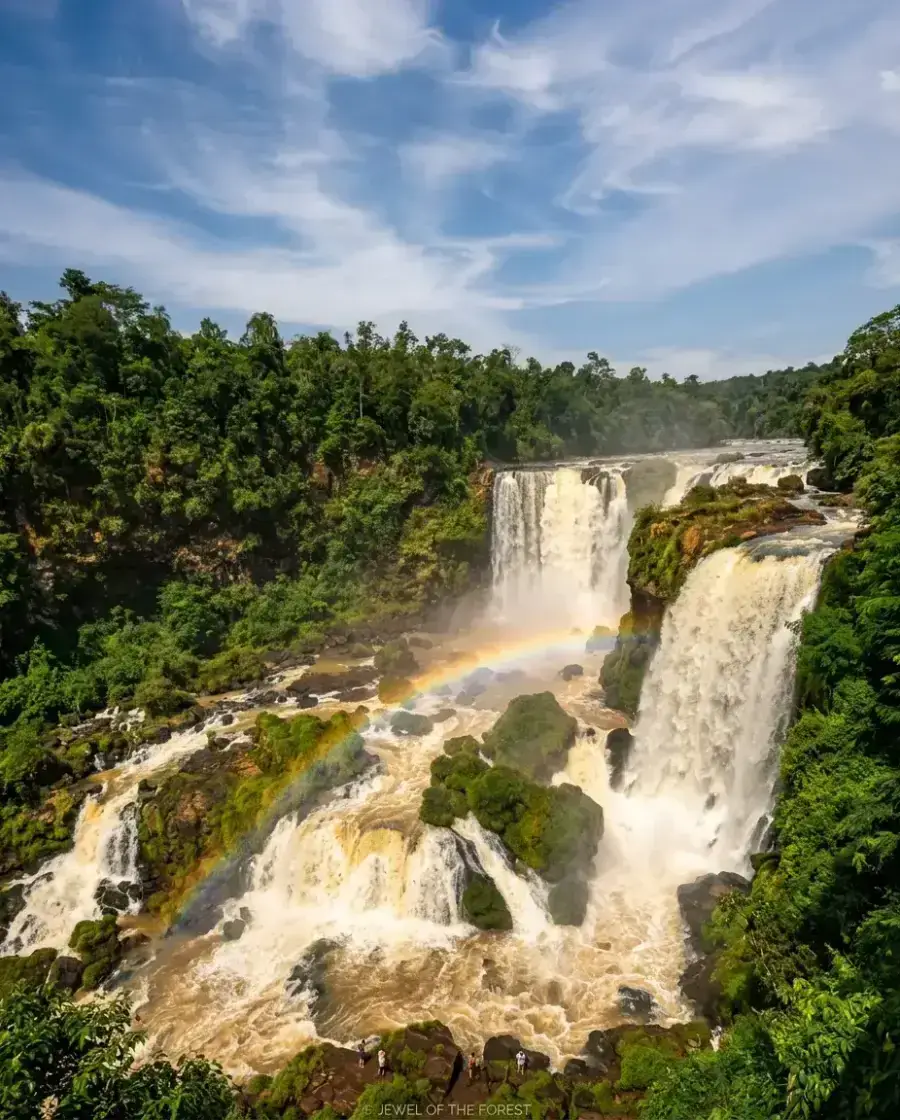

Eastern Paraguay is the country's most contrasting region: on one side, Ciudad del Este and its border economy geared toward Brazil and Argentina, driven by one of the largest hydroelectric dams in the world; on the other, still uncrowded waterfalls and the last significant Atlantic Forest massif, a refuge for exceptional biodiversity and the Aché communities. It is the region of the country most turned outward, but also where part of its ecological future is at stake. I have gathered here what you need to know before venturing out, from the Friendship Bridge to the Mbaracayú canopy.
To remember about Eastern Paraguay
- 1Ciudad del Este: 2nd city of the country, founded in 1957, heart of border trade with Brazil and Argentina
- 2Itaipu: 14,000 MW installed capacity, one of the largest hydroelectric dams in the world
- 3Monday Falls (renamed Cataratas del Monday in 2024): 40 m high, 10 km from Ciudad del Este
- 4Coronel Oviedo: crossroads founded in 1758, capital of the Caaguazú department
- 5Salto Cristal: 30 m waterfall near La Colmena, founded by Japanese immigrants in 1919
- 6Mbaracayú Reserve: 64,406 ha, the country's last great Atlantic Forest massif
A region shaped by the border and energy
Eastern Paraguay owes its current physiognomy to two 20th-century political decisions. The first is the "March to the East" launched by Alfredo Stroessner's regime in the 1950s, a voluntarist colonization policy that sought to reach the Atlantic Ocean through Brazilian territory and populate a region that was then mostly forested. The second is the construction of the Itaipu dam in the 1970s-1980s, a titanic project that transformed Ciudad del Este and the entire region into a major economic hub, while also altering the ecosystem of the Paraná River.
This dual origin, political and industrial, explains why Eastern Paraguay looks so little like the rest of the country: rapid urbanization, a strong Brazilian presence, an economy oriented toward trade and energy rather than the traditional agriculture of rural Paraguay.
What energy has changed in the region
Beyond the numbers, Itaipu transformed the regional economy in depth: direct and indirect jobs, urban development of Ciudad del Este and Hernandarias, industrial tourism attracting over a million visitors per year. The dam remains a politically sensitive issue between Asunción and Brasilia, particularly on the question of the price of unused Paraguayan energy sold to Brazil, a point detailed on the page economy of Paraguay.
A still-preserved nature, away from the major flows
Far from the border bustle, Eastern Paraguay preserves remarkable natural spaces still little known to international travelers. The Mbaracayú reserve, in the Canindeyú department, protects the country's last great Atlantic Forest massif, one of the most threatened ecosystems in South America. Further south, the Salto Cristal and Monday Falls offer more accessible alternatives for those seeking coolness and nature without straying too far from the main axes.
By your interests
| What you're looking for | |
|---|---|
| Trade and border | Ciudad del Este |
| Major infrastructure | Itaipu Dam |
| Accessible waterfall | Monday Falls (10 km from Ciudad del Este) |
| Hidden waterfall | Salto Cristal, La Colmena |
| Stopover | Coronel Oviedo |
| Nature and biodiversity | Mbaracayú Reserve |
Recommended itineraries
- 12 days: Ciudad del Este, Itaipu, Monday Falls.
- 24 days: Coronel Oviedo as a stopover, Ciudad del Este, Itaipu, Monday Falls, possible extension to Iguazu on the Brazilian side.
- 36-7 days: add the Mbaracayú reserve (2-3 days with ecolodge accommodation) and Salto Cristal on the way back to Asunción.
Sources
My method
This page is written from France, sourced as carefully as possible, but I can be wrong or miss on-the-ground detail. A price that changed, outdated info, a photo to share? Every correction is credited if you want.
Report an error or send info →Share